The Best Knife for Home Cooking: Why a Chef's Knife Comes First
Published 22 January 2026 · Updated 12 October 2026
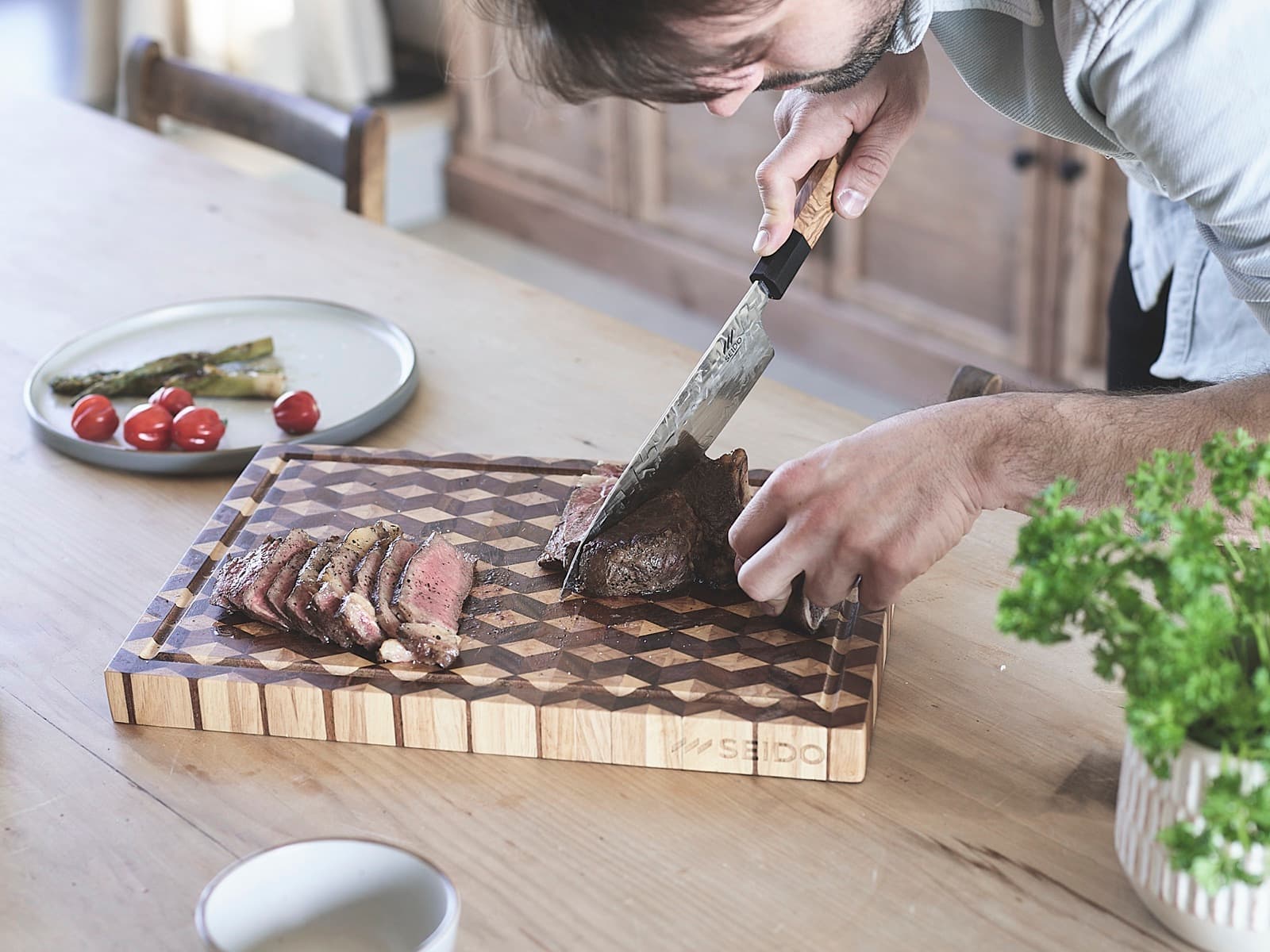
For most home cooks, the best first knife is a chef's knife. One blade of around 20 cm (8 in) chops, slices, dices and minces almost everything a home kitchen prepares, from onions and herbs to chicken and steak. Add a small paring knife and a serrated bread knife, and the everyday kit is complete.
This guide explains why a chef's knife does so much, which other knives earn a place beside it, and what to look for when you choose one: the blade, the handle, the size, the weight, the care it needs and the warranty. The advice applies to any chef's knife; where the SEIDO Cookware chef's knife fits is set out at the end.
Why does a chef's knife cover most kitchen prep?
Because every part of the blade has a job. The pointed tip does fine work, such as scoring or mincing a clove of garlic. The curved middle of the edge, the belly, rocks through a pile of herbs. The flatter stretch near the handle, the heel, takes firm cuts through carrots and onions. And the flat of the blade crushes garlic and carries chopped food from the board to the pan.
Its length does the rest. A blade of around 20 cm (8 in) is long enough to slice through a large onion or a chicken breast in one stroke, and short enough to control on an ordinary chopping board. Two motions — the push cut, driving the blade forward and down, and the rocking cut, tip on the board — cover almost every everyday job, including these:
- Dicing onions, shallots and peppers
- Slicing carrots, courgettes and potatoes
- Chopping herbs and mincing garlic and ginger
- Cutting chicken, steak and fish into portions
- Shredding cabbage and greens
- Halving melons and other large fruit
What can't a chef's knife do well?
Three kinds of job are better left to other knives. Crusty bread needs the teeth of a serrated knife: they saw through the crust, where a straight edge tends to squash the soft loaf beneath. Small jobs held in the hand — peeling an apple, hulling strawberries, trimming sprouts — are easier with a short paring knife. And bones, frozen food and hard rinds call for a cleaver or a knife made for them: a chef's knife has a fine edge, and twisting or hammering it through something hard can chip it.
Which knives should you add after a chef's knife?
Two, for most kitchens: a paring knife for small work and a serrated knife for bread. Beyond those three, add knives for the jobs you do often — a long carving or slicing knife if you roast joints most weekends, a boning knife if you joint chickens, a cleaver if you cut through bone.
A block of many knives looks generous, but the chef's knife will do most of the work; it is the one worth choosing with care. The two additions, and their usual sizes:
- A paring knife, about 8–10 cm (3–4 in) long, for small and in-hand work
- A serrated bread knife, about 20–25 cm (8–10 in) long, for loaves, cakes and anything with a hard crust and a soft middle
What should you look for in a chef's knife?
Six things, in roughly this order:
- The blade — a stainless steel blade needs the least upkeep. A listing that names the grade of steel, rather than saying only 'stainless steel', tells you more about what you are buying. Look for an edge that runs evenly from the tip to the heel.
- The handle — it should sit securely in your hand, wet or dry, with no corners that dig in where your fingers rest. Wood feels warm and needs keeping dry and oiling now and then; plastic and composite handles need little care.
- The size — around 20 cm (8 in) suits most cooks and most chopping boards; 15 cm (6 in) suits small kitchens and small boards, and 25 cm (10 in) large boards and big batches. Our knife size guide covers the choice in detail.
- The weight — a heavier knife does more of the work on dense food such as squash and root vegetables; a lighter one is quicker and less tiring for fine work. Neither is better: choose the one that feels right in your hand.
- The care it needs — most good knives are hand wash only, and every edge needs honing and occasional sharpening. Choose a knife whose care you will keep up.
- The warranty — check what it covers, for how long and how to claim.
How can you tell whether a chef's knife suits you?
If you can, hold it before you buy. Take a pinch grip — thumb and the side of your bent index finger on the blade just in front of the handle, the other three fingers wrapped round the handle — and go through a few cutting motions on a board. Your knuckles should clear the board when the edge touches it, and nothing should rub or press on your fingers.
Buying online, read the listing for the blade length in centimetres, the steel, the handle material and shape, the care instructions and the warranty, and check the returns policy before you order.
Where does the SEIDO Cookware chef's knife fit?
By size class, the SEIDO Cookware chef's knife is an eight-inch chef's knife — the all-purpose size described above — with a blade of about 22 cm (8.7 in). It has a VG10 steel core clad in Damascus stainless steel, an octagonal olive wood handle, and it comes in a hinged gift box.
It is hand wash only, the insert that comes with it recommends honing every 2–3 uses, and it carries a 5-Year Limited Warranty. The SEIDO Cookware 20 cm Honing Steel is sold separately.
Cutting this way is what our chef's knife is built for.
Frequently asked questions
- What is the most useful knife for a home cook?
- A chef's knife. Its length, curved edge and pointed tip let one blade chop, slice, dice and mince most everyday ingredients, from onions and herbs to meat and fish. It handles most kitchen prep on its own; a paring knife for small work and a serrated knife for bread cover the rest.
- Which three knives does a kitchen need?
- A chef's knife for most prep, a paring knife of about 8–10 cm (3–4 in) for small and in-hand jobs, and a serrated bread knife for crusty loaves and cakes. Other knives — carving, boning, a cleaver — are worth adding only for jobs you do often.
- Do I need a knife block set?
- Not to cook well. A set gives you many shapes, but the chef's knife does most of the work. One carefully chosen chef's knife, a paring knife and a bread knife cover everyday cooking; a block set makes sense if you want the extra shapes and will use them.
- Can you cut bread with a chef's knife?
- You can, but a serrated bread knife does it better. A straight edge tends to squash a soft loaf before it gets through the crust, and sawing through hard crusts is hard on a fine edge. Keep the chef's knife for prep and use a bread knife for loaves, cakes and crusty rolls.
- What is the difference between a chef's knife and a paring knife?
- Size and job. A chef's knife, usually 20–25 cm (8–10 in), is the all-rounder for chopping and slicing on a board. A paring knife, about 8–10 cm (3–4 in), is for small, precise work, often held in the hand: peeling, trimming, hulling and scoring.
- Is a heavier chef's knife better?
- Not necessarily. Extra weight helps a blade through dense food such as squash and root vegetables, while a lighter knife is quicker and less tiring for fine work like herbs. The right weight is the one that feels comfortable and controlled in your hand.
Browse all kitchen tools or keep reading: Damascus Chef's Knife Care Guide · Honing Steel Care Guide · Serrated Peeler Care Guide.
SEIDO Damascus Stainless Steel Chef's Knife
See the chef's knife