The Complete Knife Care Handbook: Washing, Boards, Storage, Honing and Sharpening
Published 1 July 2025 · Updated 12 October 2026
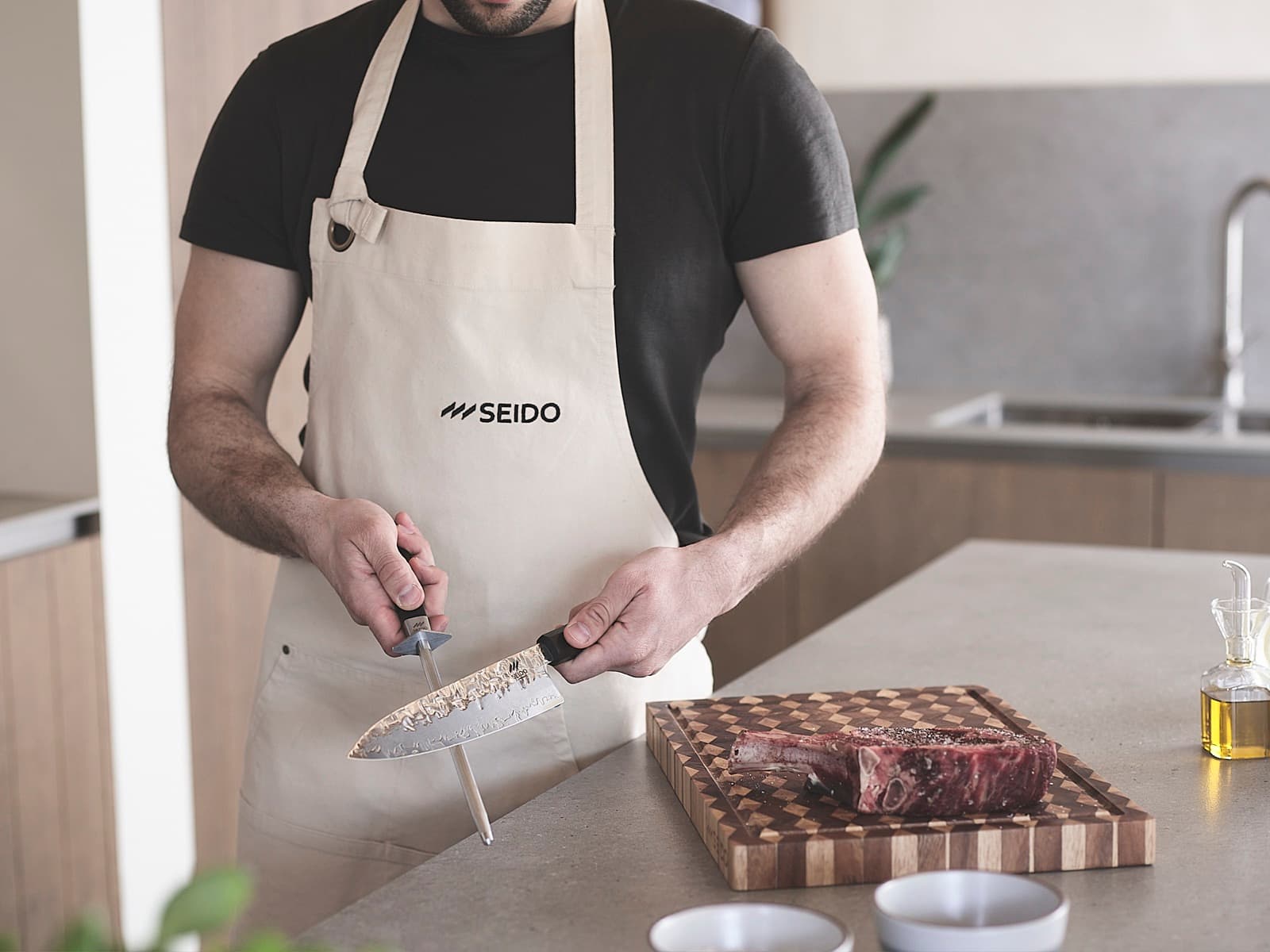
Look after a kitchen knife by washing it by hand and drying it straight away, cutting on a wooden or plastic chopping board, and storing it where the edge cannot knock against other tools. Hone it little and often to keep the edge in line, and sharpen it when honing no longer brings back a clean cut.
Most damage to a knife comes from habits rather than from cooking: the dishwasher, a glass board, a crowded drawer, a blade left to soak. This handbook takes each part of the routine in turn — washing and drying, chopping boards, storage, honing, sharpening and handle care — and ends with the few things never to do with a good knife. It applies to any plain-edged kitchen knife, the SEIDO Cookware chef's knife included.
Why does knife care matter?
A sharp, well-kept knife does what you ask of it. The edge bites where you place it, so you need only light pressure and you stay in control of the cut. A blunt edge skids off a tomato skin or the shiny outside of an onion, and the extra force you add to make it bite is what makes a blade slip.
Care also decides how long a knife stays in good order. A cutting edge is extremely fine and easily damaged, and most of the harm a knife suffers happens away from the food — in the sink, the dishwasher and the drawer. A few habits, kept every time, protect the edge between sharpenings.
How should you wash and dry a kitchen knife?
By hand, soon after use. Use warm water, a little washing-up liquid and a soft sponge or cloth. Hold the knife by the handle with the edge pointing away from you and wipe along the blade from heel to tip, keeping your fingers on the spine side. Rinse it, then dry the blade and the handle straight away with a clean tea towel.
Do not leave a knife to soak or to sit in the washing-up bowl. Long soaking is hard on handles, wooden ones above all, and a blade hidden under the suds is easy to grab by the edge. Wash knives on their own, or last, and put them away dry.
Wash promptly after acidic or salty foods — lemons, tomatoes, onions, brines and marinades. Stainless knife steels resist rust, but they are not rust-proof, and acid or salt left drying on a blade can leave spots.
Why not the dishwasher? During a cycle, blades knock against other items, which can dull or chip a fine edge; dishwasher detergents are harsher than washing-up liquid; and long spells of heat and moisture are hard on handles. Some knives are sold as dishwasher safe, and the maker's instructions come first, but hand washing is kinder to any edge. The routine, in short:
- Wash soon after use, by hand, in warm water with washing-up liquid
- Use a soft sponge or cloth — a scourer or steel wool scratches the blade
- Keep the edge pointing away from you as you wipe
- Dry the blade and the handle straight away with a clean tea towel
- Never leave a knife to soak, or hidden in the washing-up bowl
What is the best chopping board for knives?
Wood or plastic. Both give slightly under the edge, so it meets the board without being ground down. Glass, marble, granite, slate, ceramic plates and metal trays do not give at all, and they blunt an edge quickly.
Wooden boards come in two kinds. On an edge-grain board, the long fibres of the wood run along the surface. On an end-grain board, the cut ends of the fibres face upwards, so the edge slips between them rather than across them — easy on the edge, and the surface tends to close up behind it. Plastic boards are light and simple to keep clean, and many can go in the dishwasher; replace one once deep grooves set in, because grooves trap food and are hard to clean.
Two habits protect the edge on any board. Put a damp cloth or a non-slip mat under the board so it cannot slide. And move chopped food with the back of the blade, not the edge: dragging the edge sideways across a board is one of the quickest ways to blunt a knife.
How should you store kitchen knives?
So that their edges touch nothing. A loose knife in a drawer knocks against other tools every time the drawer opens, and a hand reaching in can find the edge before it finds the handle. Any of these works:
- A knife block — put knives in clean and completely dry, each in a slot that fits its blade
- A magnetic strip — set the spine against the strip first and lay the blade flat; to take it off, lift it away spine first rather than sliding it, so the edge never drags across the strip
- An in-drawer knife organiser that holds each blade in its own slot
- A blade guard or sheath, slid on only when the blade is dry
What is the difference between honing and sharpening?
They are two different jobs. A knife's edge is so fine that, with use, it bends slightly out of line — cooks say it has rolled — and the knife feels dull even though the edge is still there. Honing pushes the edge back into line and removes little or no metal. Sharpening grinds away a little metal to form a new edge, and is needed only when the old one has worn.
Hone little and often. Hold the honing steel upright with its tip on a board or a folded cloth. Set the heel of the blade against the rod near the top, at roughly the angle of the edge itself, and draw the blade down and towards you so the whole edge passes the rod from heel to tip. Alternate sides, a few light strokes each, then wipe the blade. Light, even strokes realign an edge; heavy ones can damage it.
For the SEIDO Cookware chef's knife, the insert that comes with the knife recommends honing every 2–3 uses.
To check the result, slice a ripe tomato: a well-kept edge starts the cut through the skin with little pressure. If the knife still skids or tears after honing, the edge has worn and it is time to sharpen.
How do you sharpen a kitchen knife?
There is no fixed timetable: how often a knife needs sharpening depends on how much you cook, what you cut and what you cut on. Let the knife tell you. When honing no longer brings back a clean cut, sharpen it.
Whichever route you take, sharpen at roughly the angle of the existing edge, and leave serrated knives, such as bread knives, to a tool or a service made for serrations. There are three common routes:
- A whetstone — a sharpening stone, used with water or oil according to the stone, which gives you the most control. A coarser grit forms the edge and a finer grit refines it. Hold a steady angle and work along the whole edge until a slight burr — a thin lip of metal — forms along the other side, then turn the knife over and finish with light, alternating strokes.
- A manual or electric sharpener — quick and simple. Most guide the blade at a set angle, so check that the angle suits your knife, and use light strokes: these can remove more metal than you need.
- A sharpening service — many kitchen shops, hardware shops and independent knife sharpeners will sharpen knives for you, in person or by post.
How do you look after a knife handle?
Handles need less care than blades, but they need some. Wooden handles are the ones to watch: wood swells when it is soaked and can crack as it dries out again. Keep a wooden handle dry, and every so often rub in a little food-safe oil or wax, such as food-grade mineral oil or beeswax, with a soft cloth. Leave it to soak in, then wipe off the excess.
Plastic and composite handles need only washing and drying. On any handle, check the join with the blade now and then, because food and water collect in gaps; a handle that cracks, loosens or moves on its rivets is a reason to stop using the knife until it is repaired or replaced.
The SEIDO Cookware chef's knife has an octagonal olive wood handle and is hand wash only. Oiling the handle now and then keeps the wood from drying out.
What should you never do with a kitchen knife?
A kitchen knife is a cutting tool, not a lever, a tin opener or a screwdriver. Used for cutting, and for nothing else, it needs only the routine above. These are the habits that do knives the most harm:
- Running it through the dishwasher
- Leaving it to soak, or hidden in the washing-up bowl
- Cutting on glass, stone, ceramic or metal
- Scraping food across the board with the edge
- Cutting through bones or frozen food, or twisting and prising with the blade — use a cleaver or the right tool for the job
- Storing it loose in a drawer
- Trying to catch a falling knife — step back and let it drop
Cutting this way is what our chef's knife is built for.
Frequently asked questions
- How often should you sharpen a kitchen knife?
- There is no fixed timetable. It depends on how much you cook, what you cut and what you cut on. Hone the knife little and often to keep the edge in line, and sharpen it when honing no longer brings back a clean cut — when it skids on a tomato skin or tears rather than slices.
- Is a honing steel the same as a knife sharpener?
- No, although shops often sell honing steels as sharpeners. A honing steel pushes an edge that has rolled with use back into line and removes little or no metal. Sharpening grinds away a little metal to form a new edge, on a whetstone, with a sharpener or at a sharpening service. You hone often and sharpen occasionally.
- Why do kitchen knives go blunt so quickly?
- Usually because of habits, not cooking. Hard surfaces such as glass, stone and ceramic, the knocks of a dishwasher, scraping food across the board with the edge and a crowded drawer all damage a fine edge. Cutting on wood or plastic, washing by hand, storing knives safely and honing them regularly keep an edge cutting cleanly for longer.
- How do you remove rust spots from a kitchen knife?
- Light surface spots usually come off with a paste of bicarbonate of soda and water, or a non-abrasive cleaner made for stainless steel. Rub gently along the blade, not across the edge, with a soft cloth, then rinse and dry straight away. Then deal with the cause: a blade left wet, or acidic or salty food left drying on it. Pits that will not rub out are corrosion in the steel itself.
- Can you use olive oil on a wooden knife handle?
- It is better not to. Cooking oils such as olive oil and sunflower oil can turn rancid in the wood over time and leave the handle sticky and stale-smelling. Use a food-safe mineral oil or beeswax instead: rub a little in with a soft cloth, leave it to soak in and wipe off the excess.
- Is a blunt knife more dangerous than a sharp one?
- In everyday use, it can be. A blunt edge needs more force and tends to skid off firm or shiny skins, and a blade that skids can cut the hand guiding the food. A sharp edge bites where you place it with light pressure, which keeps the cut under control. Whatever the knife, guide the food with your fingertips tucked under, knuckles forward.
Browse all kitchen tools or keep reading: Damascus Chef's Knife Care Guide · Honing Steel Care Guide · Serrated Peeler Care Guide.
SEIDO Damascus Stainless Steel Chef's Knife
See the chef's knife