Precision in Cookware Design: Form Meets Function
Published 10 July 2025 · Updated 12 October 2026
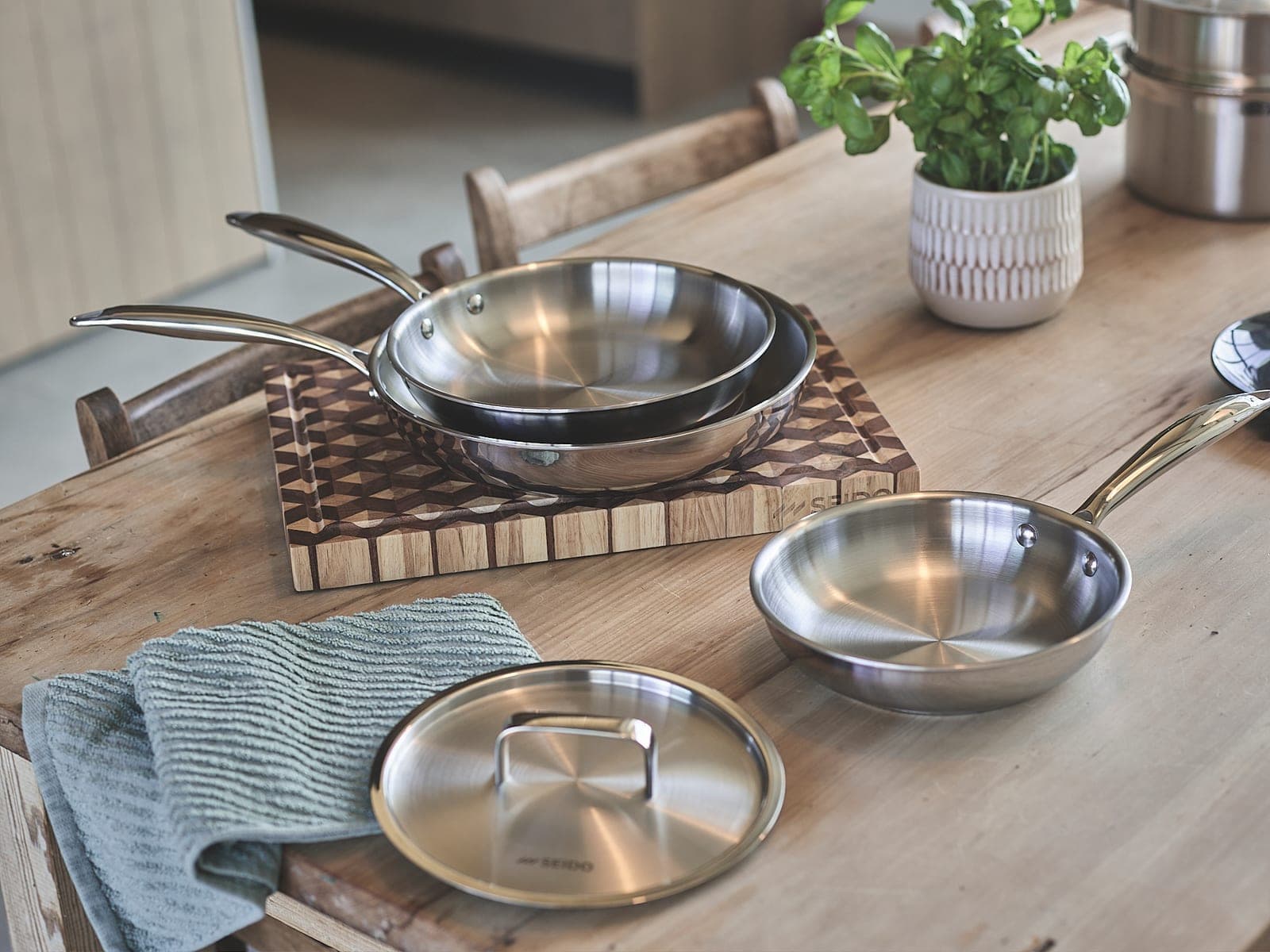
A frying pan's design works when every part has a job and does it. The handle's angle and length give you leverage and keep your hand clear of the heat. The rim decides how cleanly the pan pours. Weight and balance decide how it moves. The lid should sit level, and the base should sit flat on the hob.
Precision is what ties those parts together: small differences in a handle, a rim or a base show up every time you cook. This article takes each part in turn — what it does and what to look for — and shows how SEIDO Cookware's frying pans are built, so you can judge any pan by how it works rather than how it looks.
What does form meets function mean for a frying pan?
A frying pan does the same few jobs again and again. It takes heat from the hob and passes it into food, it lets you move the food and the pan, it pours off fat or sauce, and it has to come clean afterwards. Form meets function when the shape of each part serves those jobs.
So the useful questions about a pan are practical ones. How does it sit on your hob? How does it feel in one hand when it is full and hot? Where does the sauce go when you tip it? Good design answers them quietly — you notice it most when it is missing.
Why do a handle's angle and length matter?
The handle is the part you touch every time you cook. One that rises at a gentle angle from the rim keeps your hand above the heat and away from neighbouring pans, and gives you leverage when you tilt, toss or pour. A handle that runs flat brings your knuckles closer to the hob; one that climbs too steeply can feel top-heavy when the pan is full.
Length is a balance too. A longer handle gives more leverage against the weight of a full pan, but it takes more room on the hob and in the cupboard. The shape of the grip matters as much as its length: a rounded or shaped grip is less likely to twist in your hand than a thin, flat bar.
Any metal handle warms up during long cooking and is hot when it comes out of the oven, so keep a dry cloth or oven glove within reach, whatever the design.
What does the rim of a frying pan do?
The rim is where the walls of a frying pan finish, and its shape decides how the pan pours. A rim that flares outwards helps fat, stock or a pan sauce leave in a clean stream; a thick or upright edge is more likely to let liquid run down the outside of the pan.
The walls below the rim matter as well. A frying pan's sloped sides let steam escape, so food browns rather than stews, and they let you slide an omelette onto a plate or get a spatula under food without fighting the wall. A sauté pan's straight sides do a different job: they hold more liquid and keep splashes in.
How heavy should a frying pan be?
Weight is a rough guide to how much metal a pan has, and metal is what stores and spreads heat. A very thin, light pan tends to lose heat quickly when cold food goes in and can heat unevenly; a very heavy one is hard to lift with one hand, and a pan you struggle to lift is a pan you leave in the cupboard.
Balance matters more than the number on the scales. Pick the pan up by its handle and notice whether it pulls sharply forwards. Then picture it full — two chicken breasts and a pan sauce, the weight sitting at the far end of the handle. A well-balanced pan stays steady in one hand when you tilt it to baste or pour.
Construction plays a part. Clad cookware bonds a layer of aluminium, which conducts heat far better than stainless steel, between layers of stainless steel, so you cook on stainless steel with a conductive core behind it. SEIDO frying pans have a tri-ply clad body: a 304 (18/8) stainless steel cooking surface, an aluminium core and a 430 stainless steel exterior.
Why does a flat base matter on a modern hob?
On a ceramic hob, heat passes into the pan where the base touches the glass, so a base that sits flat heats across its whole width, while a base that rocks or bows leaves part of the pan cooking more slowly. Induction works differently — the hob heats a magnetic pan base directly — but it also relies on a base that sits flat and close to the glass. On gas, the flame wraps around the base, so small differences matter less.
Induction adds one more requirement: the base must be magnetic. A fridge magnet that grips the underside firmly is a quick check, but the maker's own statement is the one to rely on.
Flatness is also something you protect. Plunging a hot pan into cold water, or heating an empty pan on a high setting for a long time, is how pans warp. Let the pan cool before washing it, preheat over a medium heat and use a hob ring close to the size of the base.
SEIDO frying pans work on gas, electric, ceramic and induction hobs.
What makes a frying pan lid fit well?
A lid turns a frying pan into a pan you can steam, braise and gently finish in. It holds in steam to set the top of an egg without flipping it, keeps splashes down and lets vegetables soften in their own moisture. To do any of that it has to sit level on the rim, without rocking or sliding.
Check the lid's handle as well: it should be fixed securely and leave room for your fingers. Lift a lid away from you, so the steam escapes on the far side.
A lid's limits are not always the pan's limits, so read them separately. SEIDO frying pans come with a matching stainless steel lid. The pan is oven-safe to 260°C (500°F) for up to 1 hour, and so is its matching stainless steel lid.
Why is the cooking surface part of the design?
The surface the food touches is the part of a pan you use most. A coated surface is a layer applied to the pan, and every applied layer wears with heat, utensils and time. An uncoated stainless steel surface is the pan itself: there is no coating to scratch, flake or wear away, and it builds the browned fond that turns into a pan sauce.
The trade-off is technique. Preheat the dry pan over a medium heat, test with a drop of water — it should bead and glide — then add oil, then food. Food that grips the steel at first lets go once a crust has formed. SEIDO frying pans are uncoated and made without intentionally added PFAS.
How do SEIDO frying pans put precision into practice?
The name SEIDO derives from 精度 (seido), the Japanese word for precision — a standard, not a place of origin. In a frying pan, that standard means stating exactly what the pan is made of and what it is rated for, and leaving out anything that cannot be shown.
SEIDO Cookware makes three frying pans in its Sear Series: 20 cm (8 in), 24 cm (9.5 in) and 28 cm (11 in). What changes between them is capacity, not construction.
- Tri-ply clad body: a 304 (18/8) stainless steel cooking surface, an aluminium core and a 430 stainless steel exterior
- Uncoated cooking surface, made without intentionally added PFAS
- Works on gas, electric, ceramic and induction hobs
- Oven-safe to 260°C (500°F) for up to 1 hour
- A matching stainless steel lid with every pan
- 5-Year Limited Warranty; sold in the UK on Amazon.co.uk
Cooking this way is what our 24 cm frying pan is built for.
Frequently asked questions
- What makes a good frying pan handle?
- A good frying pan handle rises at a gentle angle from the rim, which keeps your hand above the heat and gives leverage for tilting and tossing. It should be long enough to balance a full pan, fixed securely and shaped so it does not twist in your hand. Any metal handle is hot after time in the oven, so use a dry cloth or oven glove.
- Why do frying pans have sloped sides?
- Sloped sides let steam escape, so food browns instead of stewing, and they make it easy to toss food, get a spatula underneath and slide an omelette onto a plate. A rim that flares outwards also helps fat and sauces pour in a clean stream. Straight sides belong to a sauté pan, which is built to hold more liquid.
- Does a frying pan need a flat base for an induction hob?
- It needs a magnetic base, and it works best when that base sits flat on the glass. A base that rocks or bows makes poorer contact on ceramic and induction hobs, so part of the pan heats more slowly. Protect flatness by letting a hot pan cool before washing it and by preheating over a medium heat rather than a high one.
- How heavy should a frying pan be?
- Heavy enough to hold its heat when food goes in, light enough to lift with one hand when it is full. There is no single right weight, and balance matters more than the number: pick the pan up by its handle, and if it pulls sharply forwards, it will feel heavier in use than its weight suggests.
- Can the lid of a SEIDO frying pan go in the oven?
- No. SEIDO frying pans are oven-safe to 260°C (500°F) for up to 1 hour. The matching stainless steel lid can go in with it, so a dish can braise covered on the hob and finish in the oven.
- What are SEIDO frying pans made of?
- SEIDO frying pans have a tri-ply clad body: a 304 (18/8) stainless steel cooking surface, an aluminium core and a 430 stainless steel exterior. The cooking surface is uncoated and made without intentionally added PFAS. The pans come in 20 cm (8 in), 24 cm (9.5 in) and 28 cm (11 in), each with a matching stainless steel lid and a 5-Year Limited Warranty.
Browse all stainless steel frying pans or keep reading: Can You Cook Acidic Foods in Stainless Steel? · Can You Put a Stainless Steel Pan in the Oven? · How Hot Should a Stainless Steel Pan Be?.
SEIDO 24 cm Stainless Steel Frying Pan
See the 24 cm frying pan