Is a Good Chef's Knife Worth the Investment?
Published 15 December 2025 · Updated 12 October 2026
For anyone who cooks most days, a good chef's knife is usually worth the investment. It does most of the prep, so it is used more than any other knife, and a well-made one that is looked after stays in service for many years. You are paying for the blade steel, the construction, the handle and the warranty.
It is only worth it, though, if you will look after it: hand washing, a decent chopping board, regular honing and the occasional sharpening are part of the deal. This article sets out what the money buys in any good chef's knife, what is not worth paying extra for, and how to judge the knife in front of you.
What makes a chef's knife worth paying more for?
How much you use it. A chef's knife does most of the chopping, slicing and dicing in a home kitchen, so it is in your hand for almost every meal you cook. A knife used nearly every day for years costs very little per use, whatever it cost on the day; a drawer of knives you rarely reach for costs more per use than it looks.
So the better question is not 'how much?' but 'what am I paying for?' Five things separate a good chef's knife from an ordinary one, and each can be checked before you buy: the steel, the construction, the handle, the care it needs and the warranty.
What are you paying for in the blade steel?
The steel decides how an edge behaves. Harder steels can take and keep a finer edge, but they are less forgiving: twist them or catch a bone and the edge can chip. Softer steels are tougher and quicker to sharpen, but their edges roll sooner and need honing and sharpening more often. Neither is wrong; they are different trade-offs.
Stainless steels resist rust and ask for little more than prompt drying. Carbon steel, which is not stainless, rusts and discolours if it is left wet and needs more care. And how a steel is heat-treated matters as much as which steel it is.
A listing that names the grade of steel, rather than saying only 'stainless steel', tells you what you are buying and lets you look it up. The SEIDO Cookware chef's knife names its own: a VG10 steel core, VG10 being a stainless steel grade used for kitchen knife blades.
What does the construction add?
A blade is either one steel all the way through or clad. A single-steel blade is simple and sturdy. A clad blade is built in layers: a core steel runs through the centre and forms the cutting edge, and a different steel covers it on both faces, so a maker can choose one steel for the edge and another for the outside of the blade.
Whether a blade was forged or cut from sheet steel matters less than many buyers think: the steel, its heat treatment and the grind decide how a knife cuts. What you can check by eye and hand is the finish — a spine and heel whose corners are eased so they do not dig into your fingers, a handle that meets the blade without gaps where food and water collect, and an edge that runs evenly from heel to tip.
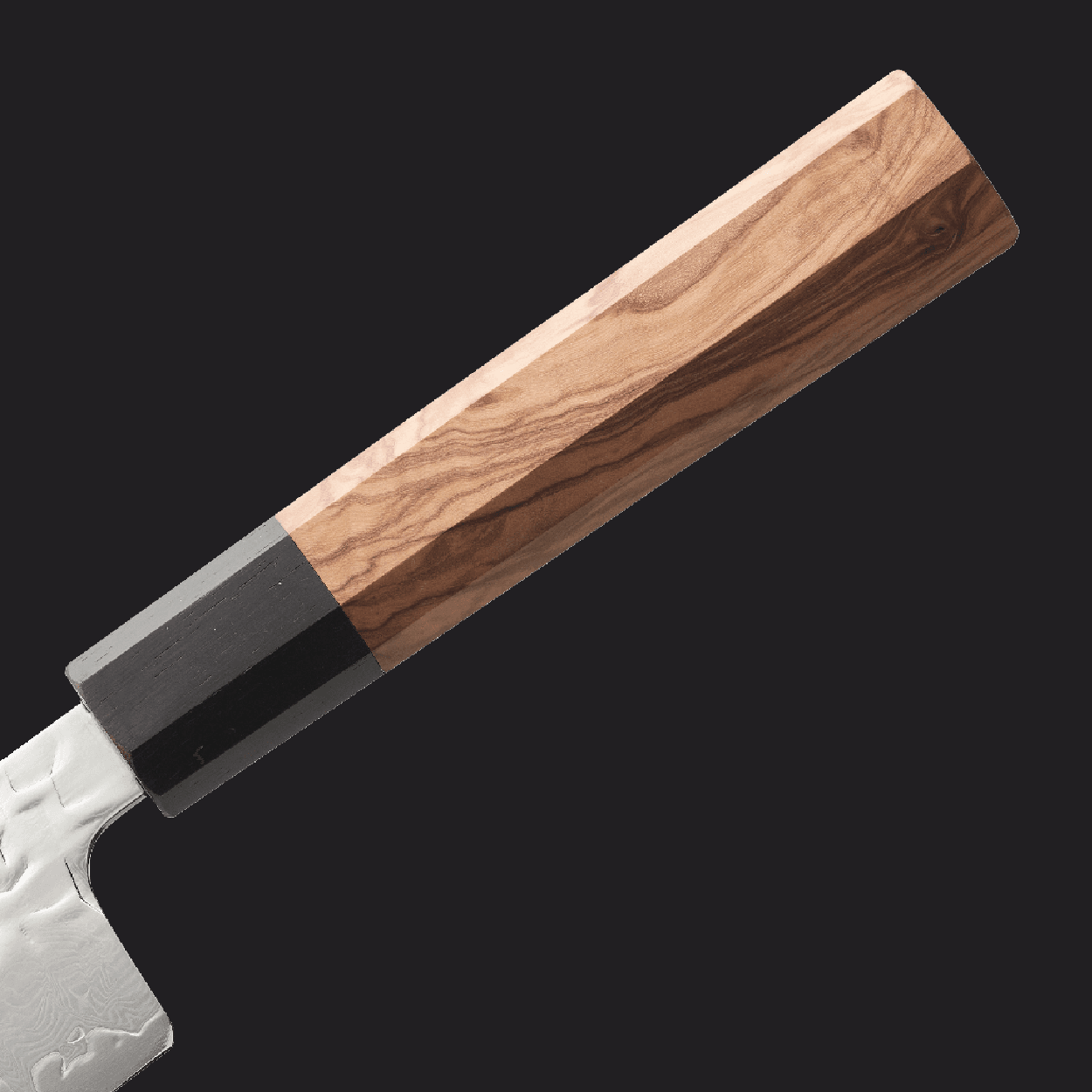
The SEIDO Cookware chef's knife is a clad blade: a VG10 steel core clad in Damascus stainless steel, whose layered pattern shows along the blade. Its handle is octagonal olive wood, with eight flat faces rather than a round profile.
Why does the handle matter so much?
You hold the handle for every cut, so it is where a knife feels right or wrong. Look for a shape that sits securely in a pinch grip without rubbing or pressing anywhere, and for a material you are happy to look after. Three things to weigh:
- Wood — warm in the hand, with a grain of its own; keep it dry and oil it now and then
- Plastic and composite — hard-wearing and low-maintenance; the feel depends on the shape and the surface
- Shape — round, oval, D-shaped and octagonal handles all have their fans; the right one is the one that suits your grip
Is care part of the cost?
Yes — and it is what turns a good knife into a good investment. A fine edge needs a wooden or plastic chopping board, a safe place to live, regular honing and, now and then, sharpening on a whetstone or by a sharpening service. Most good knives are hand wash only. None of it takes long: a minute to wash and dry, a few strokes on a honing steel. Skipping it wastes much of what you paid for the blade.
For the SEIDO Cookware chef's knife, the insert that comes with the knife recommends honing every 2–3 uses, and the SEIDO Cookware 20 cm Honing Steel is the natural partner.
What should a warranty tell you?
What it covers, for how long, and how to claim. A knife warranty worth having covers defects in materials and workmanship. Warranties do not usually cover normal wear — every edge dulls with use — and most exclude damage from misuse, such as cutting through bone or putting a hand-wash-only knife in the dishwasher.
The SEIDO Cookware chef's knife carries a 5-Year Limited Warranty covering defects in materials and workmanship under normal home use.
What isn't worth paying extra for?
Three things add to the price without adding to the cooking:
- Knives you will not use — a block of many knives looks generous, but most everyday prep falls to the chef's knife
- Looks on their own — a handsome blade is a fair thing to want, but a pattern or a finish does not tell you how a knife cuts
- Vague descriptions — choose on what a listing names plainly: the steel grade, the construction, the handle material, the care it needs and the warranty
So, is a good chef's knife worth it?
If you cook most days and will wash, hone and store the knife properly, a good chef's knife is one of the more sensible things you can buy for your kitchen: it is the tool you will reach for at almost every meal.
If you would rather put knives in the dishwasher and never think about them, a less expensive knife, kept sharp, may suit you better — and that is an honest choice too. What matters most, whatever you spend, is that the edge is kept in line and the knife is looked after.
Cutting this way is what our chef's knife is built for.
Frequently asked questions
- Are expensive kitchen knives worth it?
- They can be, if the money buys things you can check — a named steel, sound construction, a comfortable handle and a clear warranty — and you look after the knife. Price alone tells you little. A well-chosen chef's knife used most days costs little per use; an expensive knife that goes in the dishwasher and lives loose in a drawer is a poor investment.
- Does a more expensive knife stay sharp for longer?
- Not because of its price. How long an edge lasts depends on the steel, how it was heat-treated, the angle of the edge and how the knife is used, washed and stored. Every edge dulls with use; regular honing and occasional sharpening keep any good knife cutting cleanly.
- How long does a good chef's knife last?
- With care, many years. A blade wears slowly — each sharpening removes a little metal — so a knife's working life depends mostly on how it is treated: washed by hand, dried, stored safely, used on wood or plastic and sharpened when it needs it.
- What does a knife warranty usually cover?
- Defects in materials and workmanship: faults in how the knife was made. Warranties generally exclude normal wear, such as an edge that dulls with use, and damage from misuse or accident. The SEIDO Cookware chef's knife carries a 5-Year Limited Warranty covering defects in materials and workmanship under normal home use.
- Is a wooden knife handle worth having?
- If you like the feel of it and will keep it dry. Wood is warm in the hand and needs a little care: wash the knife by hand, dry it straight away and oil the handle now and then with a food-safe oil or wax. Plastic and composite handles need less looking after. Choose the material whose care you will keep up.
Browse all kitchen tools or keep reading: Damascus Chef's Knife Care Guide · Honing Steel Care Guide · Serrated Peeler Care Guide.
SEIDO Damascus Stainless Steel Chef's Knife
See the chef's knife