The Science Behind Damascus Steel: Where the Pattern Comes From
Published 15 October 2025 · Updated 12 October 2026
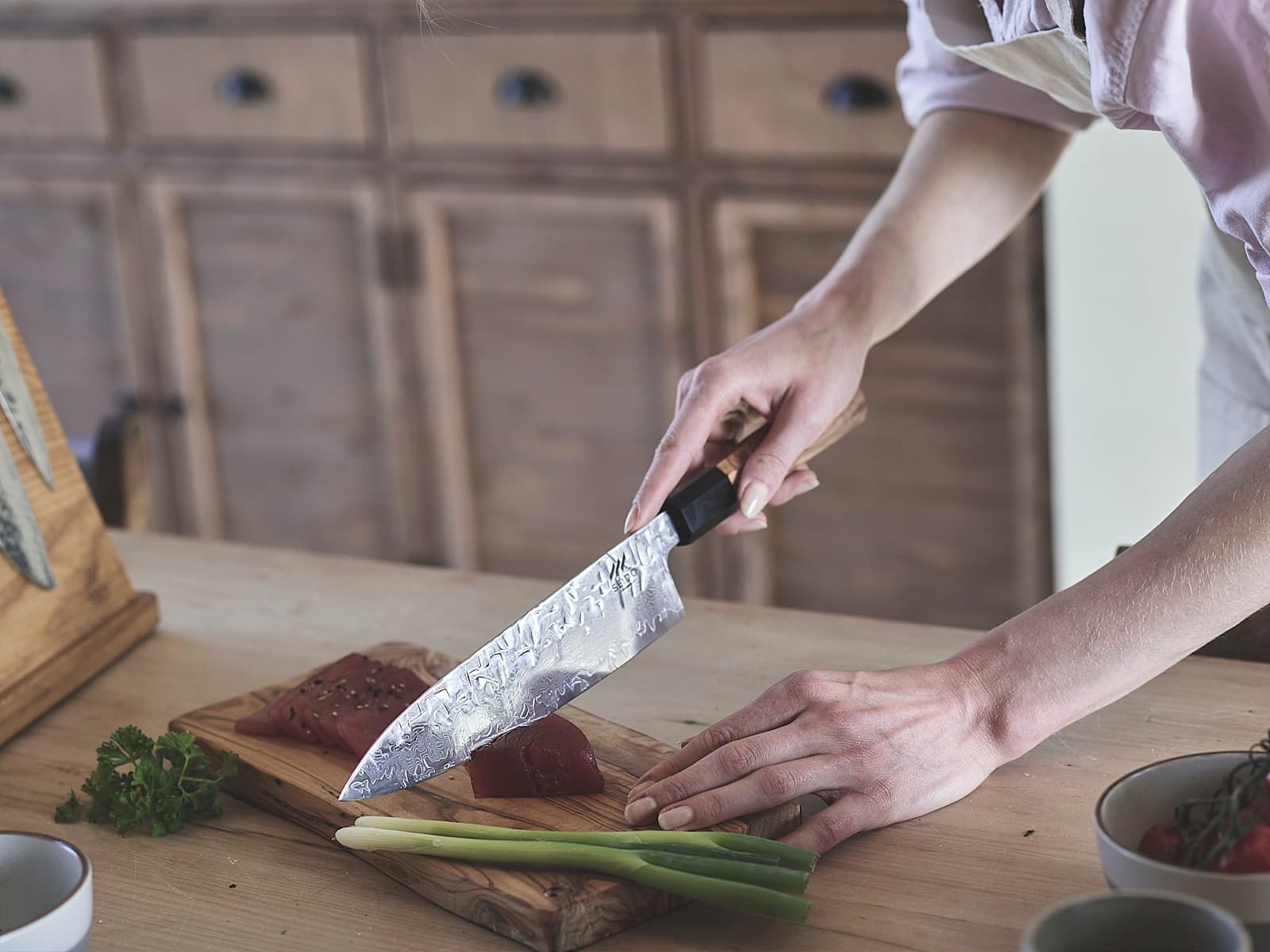
Damascus steel is steel that shows a flowing, wave-like pattern across its surface. The original blades, made centuries ago from a crucible steel later called wootz, took their pattern from bands inside a single steel. Modern Damascus is usually pattern-welded: layers of different steels joined in the forge, then etched so the layers show as light and dark lines.
On a modern kitchen knife, Damascus steel is often cladding: patterned layers covering a core of one steel, which forms the cutting edge. This article explains where the name comes from, how the old blades got their pattern, how modern Damascus is made and etched, and what the pattern does — and does not — tell you about a knife.
Where does the name Damascus steel come from?
The name goes back to sword blades from the medieval Middle East, prized for a pattern running through the steel. It is often described as watered, because it looks like the surface of moving water. The blades are linked to the city of Damascus, a centre where such weapons were made and traded, though historians still debate exactly how the name arose.
The steel itself came from further east. It arrived as small cakes of crucible steel, made by sealing iron with charcoal or plant matter in clay pots, heating them until the contents melted and letting them cool slowly. In English it came to be called wootz, a rendering of a word for steel from southern India. Southern India and Sri Lanka are the sources most often named, and crucible steel was also made in parts of Central Asia.
How did the original Damascus steel get its pattern?
The pattern came from inside a single steel, not from layers of different ones. Crucible steel of this kind holds more carbon than most steels, and as an ingot cooled slowly, part of that carbon formed tiny, very hard particles of iron carbide. Forged carefully, at a controlled heat, these particles lined up in bands.
Polishing and etching the finished blade brought the bands out: the carbide stayed bright while the steel around it darkened, giving the watered look. Modern research suggests that tiny traces of other elements in the ore, such as vanadium, helped the bands form.
Over time the method fell out of use, and for a long period no one could say exactly how the old smiths had done it. Metallurgists and bladesmiths have since made steel with the same kind of pattern by working the crucible process out again.
What is modern Damascus steel?
Nearly every Damascus blade made today, kitchen knives included, is pattern-welded. Two or more steels that react differently to an acid etch are stacked in layers, heated and forge-welded — hammered or pressed until the layers fuse into one solid block. The block is drawn out and folded, or cut and restacked, to multiply the layers, and it can be twisted or pressed to shape the pattern.
Pattern welding is an old technique in its own right: smiths in early medieval Europe used it to make sword blades. Today it is often done with stainless steels, so a modern Damascus blade can carry its pattern and resist rust at the same time.
Makers often quote how many layers a blade has. The figure describes how the pattern was built; on its own, it says little about how a knife cuts.
How does etching reveal the pattern?
A freshly ground pattern-welded blade looks almost plain, because polished steel reflects light evenly whatever it is made of. The pattern appears when the blade is etched in an acid solution. Each steel in the stack reacts at its own rate — one darkens, the other stays bright — so the layers show as contrasting lines where the grinding has cut across them.
Because the contrast sits at the surface, heavy scouring or polishing can soften it over the years. That changes the look, not the layers underneath, and gentle washing with a soft sponge helps keep the pattern clear.
What does Damascus cladding mean on a kitchen knife?
On many kitchen knives, Damascus steel is cladding. The blade is built like a sandwich: a core of one steel runs through the centre and is exposed along the cutting edge, and layers of Damascus steel cover it on both faces. The very edge is the core steel, so the core does the cutting; the cladding forms the faces of the blade and carries the pattern.
The SEIDO Cookware chef's knife is a clad blade of this kind: a VG10 steel core — a stainless steel grade used for kitchen knife blades — clad in Damascus stainless steel. The blade is about 22 cm (8.7 in) long, the handle is octagonal olive wood, and the knife carries a 5-Year Limited Warranty.
What does the pattern tell you about a knife?
It tells you how the blade is built: layered steel at the surface. It does not, on its own, tell you how the knife will cut. That depends on the steel at the edge and how it was heat-treated, on the shape of the edge and how it was sharpened, and on how the knife is looked after.
- The pattern — layers of different steels, revealed by etching
- The cutting edge — on a clad blade, the core steel alone
- How it cuts — the core steel, its heat treatment, the edge's shape and the sharpening
- How it stays cutting — all of the above, plus the chopping board, regular honing and care
Does a Damascus blade need special care?
It needs the care any good knife needs, with one extra point: keep abrasive pads and scouring powders away from the blade, to protect the etched contrast. Wash the knife by hand in warm water with washing-up liquid, dry it straight away, cut on a wooden or plastic board and store it where the edge cannot knock against other tools.
The SEIDO Cookware chef's knife is hand wash only. The insert that comes with it recommends honing every 2–3 uses and oiling the olive wood handle now and then with a food-safe oil or wax.
Cutting this way is what our chef's knife is built for.
Frequently asked questions
- Is modern Damascus steel the same as the original?
- No. The original Damascus blades were forged from crucible steel, later called wootz, whose pattern came from bands of hard carbide inside a single steel. Nearly all Damascus made today is pattern-welded: layers of different steels forged together, then etched so the layers show. Both give a flowing pattern, but they are made in different ways.
- Why is it called Damascus steel?
- The name is linked to the city of Damascus, a centre where patterned sword blades were made and traded in the medieval Middle East, though historians still debate exactly how the name arose. The steel itself arrived as small cakes of crucible steel, made in southern India and Sri Lanka, among other places.
- Is Damascus steel stainless?
- It can be. The original crucible steel was not stainless, and some modern Damascus is not either, but many kitchen knives now use stainless Damascus. The SEIDO Cookware chef's knife has a VG10 steel core clad in Damascus stainless steel. Even stainless steel can spot if it is left wet, so wash the knife by hand and dry it straight away.
- Will the pattern on a Damascus knife wear off?
- The layers run through the cladding, so the pattern stays, but the etched contrast that makes it visible can soften over years of heavy scouring or polishing. Wash the blade by hand with a soft sponge, skip abrasive pads and dry it straight away to help keep the pattern clear.
- Does the Damascus pattern make a knife sharper?
- Not on its own. On a clad knife the cutting edge is the core steel, so how sharp the knife gets and how it cuts depend on that steel, its heat treatment, the shape of the edge and the sharpening. The pattern shows how the blade is built; regular honing and careful sharpening keep the edge working.
Browse all kitchen tools or keep reading: Damascus Chef's Knife Care Guide · Honing Steel Care Guide · Serrated Peeler Care Guide.
SEIDO Damascus Stainless Steel Chef's Knife
See the chef's knife