Damascus vs German Steel Knives: Build, Edge and Care Compared
Published 20 January 2026 · Updated 12 October 2026
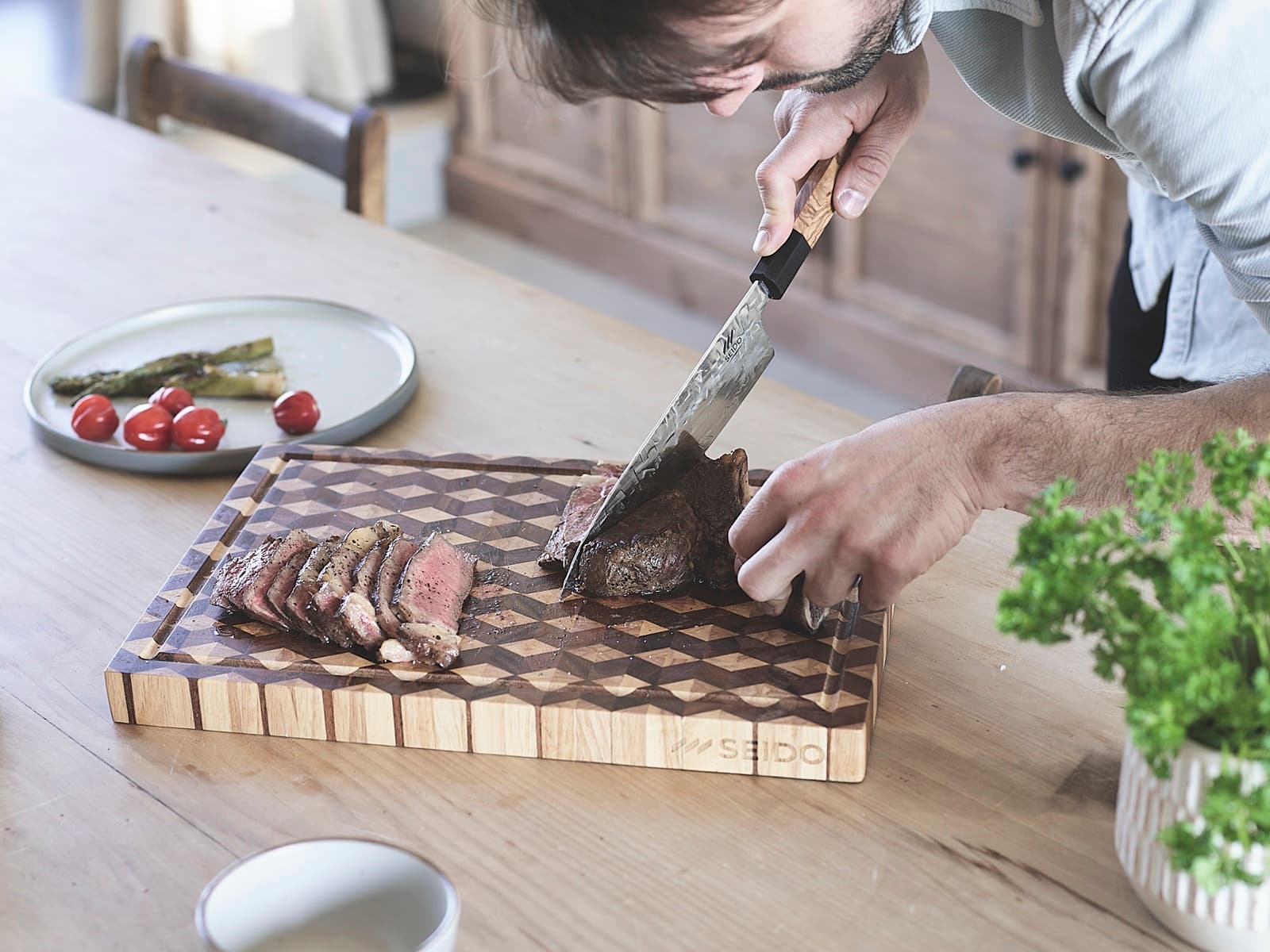
A Damascus knife is usually a clad blade: a hard steel core forms the cutting edge, with patterned Damascus layers on both faces. A typical German-style knife is one stainless steel throughout, a little softer and thicker behind the edge. The first is built for a fine edge and clean slicing; the second for toughness and easy upkeep.
Neither style suits every cook. This guide compares how each knife is built, how the edges differ, which cuts each suits, how each is honed and sharpened, and how to look after both. Exact hardness and edge angles vary from knife to knife, so treat the differences here as tendencies, not rules.
How is a Damascus-clad knife built?
A clad blade is made in layers. A core of one steel runs through the centre of the blade and is exposed along the cutting edge; other steel covers it on both faces. When that outer steel is Damascus — layers of different steels, etched so the layers show — the blade carries a flowing pattern across its faces.
The idea is to put a hard steel exactly where the cutting happens, and to use the cladding for the faces of the blade around it. The pattern is in the cladding; the edge is the core.
The SEIDO Cookware chef's knife is a clad blade of this kind: a VG10 steel core, a stainless steel grade used for kitchen knife blades, clad in Damascus stainless steel. The blade is about 22 cm (8.7 in) long and the handle is octagonal olive wood.
How is a German-style knife built?
The classic German-style chef's knife is forged from one stainless steel, with no separate core: the same steel runs from the edge to the spine. It usually has a bolster — a thick collar of steel where the blade meets the handle — and a full tang, the steel running the length of the handle between riveted handle scales.
Its steel is usually a little softer than a hard knife core, and the blade is usually thicker behind the edge. Softer steel is tougher in the everyday sense: when an edge meets a bone or the board at an awkward angle, it tends to bend rather than chip, and a few strokes on a honing steel straighten it again.
How do the edges differ?
Edge geometry is the shape of the steel just behind the cutting edge: how thick the blade is there, and how wide the angle is where the two sides meet. A thin blade with a narrow angle slides through food with little effort; a thicker blade with a wider angle stands up better to knocks.
A harder steel can support a thinner, narrower edge, which is why clad blades with a hard core are often ground thin. A softer steel ground that thin would roll out of line quickly, so German-style knives have traditionally been given a slightly thicker, wider edge. The line has blurred: many German-style knives are now sharpened more finely than they once were.
Neither style tells you how sharp a particular knife is. That comes down to how it was sharpened, and how it has been looked after since.
Which cutting style suits each?
Both chop, slice and dice. For cutting style, the profile matters more than the steel: the curve of the edge from heel to tip. German-style chef's knives are known for a generous curve, which suits a rocking cut — the tip stays on the board while the heel rises and falls. A flatter edge suits push cuts, driving the blade forward and down through the food.
Weight plays a part too. A bolster and a thick blade put weight in the hand, which some cooks like for hard vegetables such as swede and butternut squash; a thinner blade feels lighter and nimbler for fine slicing. If you can, hold both: the right one is the one that feels natural in your hand.
Neither is a cleaver. Keep both away from bones and frozen food, and never twist or lever the blade. That matters most with a hard core, which can chip where softer steel would bend.
How are they honed and sharpened?
Both need honing. The fine edge of any knife rolls slightly out of line with use, and a few light strokes on a honing steel push it back. German-style edges take readily to frequent honing because they roll rather than chip. A hard core asks for a lighter touch: a few gentle strokes per side at roughly the angle of the edge, never force. For the SEIDO Cookware chef's knife, the insert that comes with it recommends honing every 2–3 uses.
Sharpening, which grinds a new edge, is needed when honing no longer brings back a clean cut. Both styles can be sharpened on a whetstone or by a sharpening service; keep to the knife's existing edge angle, and ask the service to match it if you are unsure.
One German-style detail: a bolster that runs right down to the heel of the edge gets in the way of the stone as the edge wears back over the years, so the last part of the edge near the handle becomes harder to sharpen.
How do you look after each?
The everyday care is the same for both: wash by hand in warm water with washing-up liquid, dry straight away, cut on a wooden or plastic board and store the knife where its edge cannot knock against other tools. A dishwasher is hard on any good edge — the blade knocks against other items, and a long hot, wet cycle is hard on handles — and even stainless steel can spot if it is left wet.
A Damascus-clad blade adds one point: skip abrasive pads and scouring powders, which can soften the etched contrast of the pattern over time.
The SEIDO Cookware chef's knife is hand wash only. Oil its olive wood handle now and then with a food-safe oil or wax, such as mineral oil or beeswax, to keep the wood from drying out.
Which should you choose?
Choose by how you cook and how you like to look after a knife.
- A Damascus-clad knife with a hard core suits cooks who want a thin, fine edge for clean slicing, and who are happy to hone with a light touch and keep the blade away from bones and frozen food.
- A German-style knife suits cooks who want a heavier, tougher blade that copes with knocks and takes readily to frequent honing.
- Either way, a honing steel, a wooden or plastic chopping board and washing by hand keep the edge working.
Cutting this way is what our chef's knife is built for.
Frequently asked questions
- Is Damascus steel better than German steel?
- Neither is better for every cook. A Damascus-clad knife cuts with its core steel; when that core is hard, the blade can be ground thin for clean slicing, but it needs a lighter touch. A German-style knife is usually one softer stainless steel with a thicker edge, so it is more forgiving of knocks and frequent honing. The right choice depends on how you cook.
- Are Damascus knives harder to look after?
- They ask for more careful use rather than more work. Wash by hand and dry straight away, as with any good knife; keep a blade with a hard core away from bones, frozen food and twisting cuts; hone with light strokes; and skip abrasive pads, which can dull the etched pattern. The SEIDO Cookware chef's knife is hand wash only.
- Can you use a honing steel on a Damascus knife?
- Yes. Honing realigns the edge, which on a clad knife is the core steel. Use a few light strokes per side at roughly the angle of the edge. The insert that comes with the SEIDO Cookware chef's knife recommends honing every 2–3 uses, and the SEIDO Cookware 20 cm Honing Steel is the natural partner to it.
- Why do some knives chip while others bend?
- It comes down to the steel at the edge. A harder edge resists bending, so when it is twisted, levered or driven into bone or frozen food, it is more likely to chip. A softer edge bends instead, and honing can straighten it. Use a push or rocking cut, keep to food and a wooden or plastic board, and chips are far less likely.
- What is a German-style knife?
- A chef's knife in the classic German pattern: one stainless steel throughout, usually forged, with a bolster where the blade meets the handle, a full tang and a riveted handle. Its steel is usually a little softer than a hard knife core and its blade a little thicker, which makes it tough and forgiving in everyday use.
Browse all kitchen tools or keep reading: Damascus Chef's Knife Care Guide · Honing Steel Care Guide · Serrated Peeler Care Guide.
SEIDO Damascus Stainless Steel Chef's Knife
See the chef's knife