Damascus Chef's Knife vs Budget Kitchen Knives: Construction, Handle and Upkeep
Published 10 February 2026 · Updated 12 October 2026
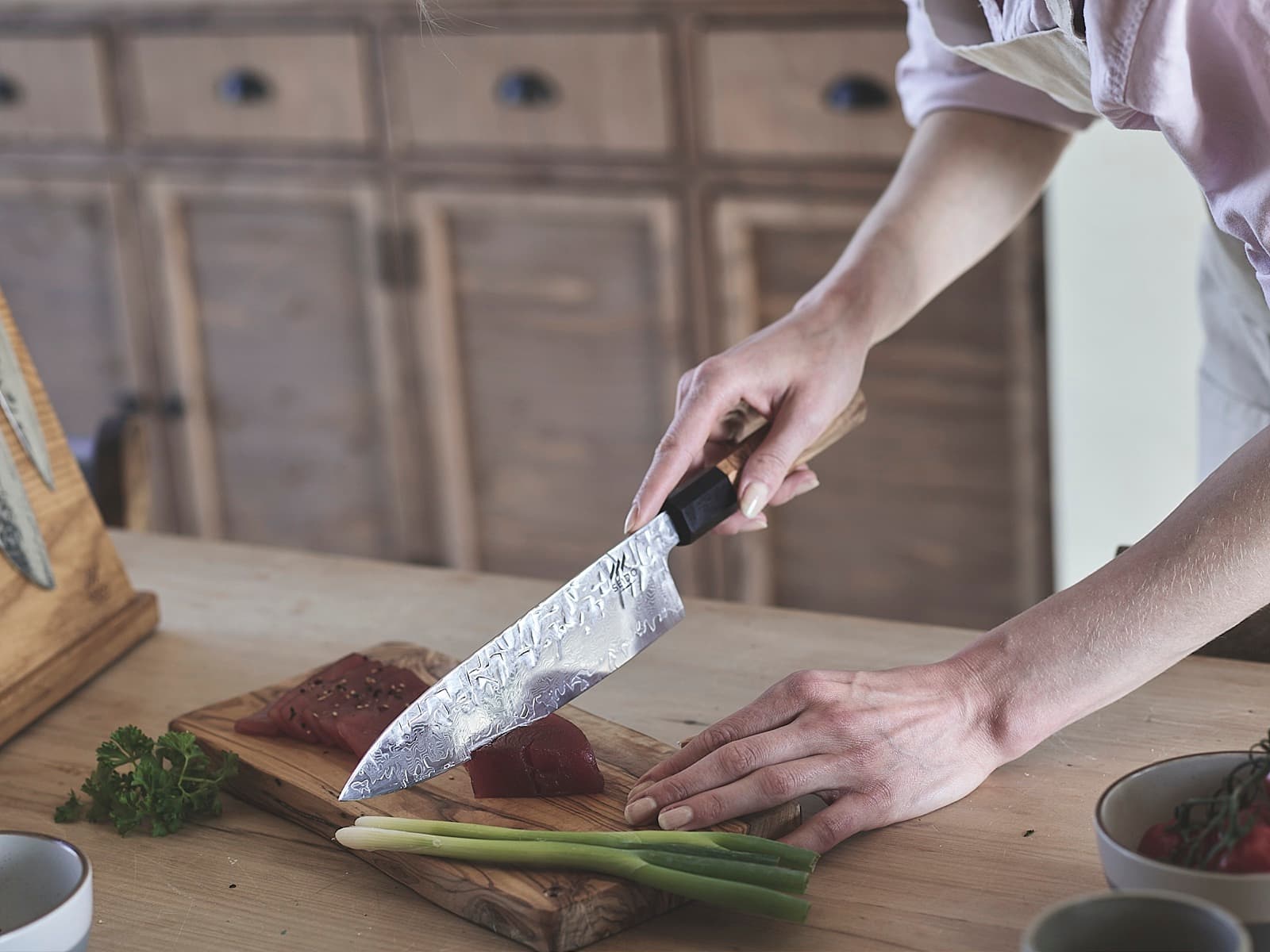
A clad Damascus-pattern chef's knife has a core steel that forms the edge, covered on both faces by layered Damascus steel; a typical budget knife is one stainless steel throughout, usually with a plastic handle. The pattern shows how the blade is built, not how well it cuts. Day to day, sharpness and care make the bigger difference.
This guide puts the two side by side — construction, handle and upkeep — explains what the Damascus pattern is and what it is not, and helps you decide which suits the way you cook. It compares the two kinds of knife in general; the SEIDO Cookware chef's knife's own specification is set out at the end.
What is a Damascus-pattern chef's knife?
A knife whose blade shows a flowing, layered pattern. Today the name describes steel made from layers of two or more different steels joined into one piece. The steels react differently when the surface is etched, so the layers show as light and dark bands. The name is borrowed from the patterned sword blades of history, which were made a different way.
In a clad Damascus-pattern kitchen knife, that layered steel is the cladding. A core of a different steel runs through the centre of the blade and is exposed along the cutting edge, and the Damascus steel covers it on both faces. The core is the steel that cuts.
How is a typical budget knife made?
Most low-priced kitchen knives are one stainless steel all the way through. The blade is usually cut, or stamped, from a sheet of steel, then hardened, ground to an edge and fitted with a handle — often moulded plastic, sometimes plastic scales riveted to the tang, the strip of steel that runs into the handle.
Many use softer stainless steels, which are tough and quick to sharpen. A good one, kept sharp, cuts well: a sharp inexpensive knife cuts better than a blunt expensive one.
How do they compare on construction?
Side by side, the differences are in how the blade is built and what that tells you:
- Blade — clad Damascus-pattern knife: a core steel inside, layered Damascus steel on both faces. Typical budget knife: one steel throughout.
- Edge — clad: formed by the core steel. Budget: formed by the same steel as the rest of the blade.
- Look — clad: the layered pattern along the blade. Budget: a plain polished or satin finish.
- What the listing tells you — a clad knife usually names its core steel; a budget knife often says only 'stainless steel'.
How do they compare on the handle?
Handles vary more than blades. Damascus-pattern knives often have wooden or wood-composite handles; budget knives usually have moulded plastic or plastic scales. Wood is warm in the hand and needs keeping dry and oiling now and then; plastic needs little care and copes well with water.
Whatever the material, the test is the same: a pinch grip that feels secure, nothing that rubs or presses on your fingers, and no gaps where the handle meets the blade.
How do they compare on upkeep?
Every knife needs the same basics: a wooden or plastic chopping board, safe storage, honing and, now and then, sharpening. The differences are in the details:
- Washing — a clad knife with a wooden handle is usually hand wash only; many budget knives are sold as dishwasher safe, though hand washing is kinder to any edge
- Drying — dry both straight away: stainless steels resist rust but are not rust-proof
- Honing — both need it, because every edge rolls with use
- Sharpening — the same routes work for both: a whetstone, a sharpener whose angle suits the knife, or a sharpening service; sharpening works on the edge, not on the faces of the blade
- The blade's surface — use a soft sponge on a Damascus-pattern blade; scourers and abrasive cleaners scratch the finish and can dull the look of the pattern
- The handle — oil a wooden handle now and then; a plastic one needs only washing and drying
What is the Damascus pattern, and what is it not?
It is the layers of the cladding, showing at the surface. On a clad knife, it tells you that the blade has a core and cladding rather than one steel — and many cooks simply like the look, which is a fair reason to choose one.
It is not the cutting edge: the core steel does the cutting. It is not a measure of hardness, sharpness or how long an edge lasts; those depend on the core steel, its heat treatment and the edge itself. And not every pattern is layered steel: some low-priced blades carry a printed or laser-etched imitation of the look on a single steel. The word 'Damascus' tells you about the look; the core steel tells you about the edge.
Which should you choose?
Choose a budget knife if you want something low-maintenance that you can replace without a second thought — and keep it sharp. Choose a clad Damascus-pattern knife if you want a named core steel inside a layered, clad blade and, often, a wooden handle, and you are happy to hand wash it, hone it and oil the handle.
Either way, the habits make the bigger difference from one month to the next: a wooden or plastic board, regular honing, prompt drying and safe storage.
What is the SEIDO Cookware chef's knife?
A clad Damascus-pattern chef's knife: a VG10 steel core clad in Damascus stainless steel — the layered pattern you can see along the blade — with a blade of about 22 cm (8.7 in) and an octagonal olive wood handle. It comes in a hinged gift box.
It is hand wash only, the insert that comes with it recommends honing every 2–3 uses, and it carries a 5-Year Limited Warranty.
Cutting this way is what our chef's knife is built for.
Frequently asked questions
- Is a Damascus knife better than an ordinary kitchen knife?
- Not because of its pattern. How a knife cuts depends on its core steel, how that steel was heat-treated, the edge and how well the knife is kept. A clad Damascus-pattern knife gives you a named core steel inside layered cladding and, often, a wooden handle; whether that suits you depends on how you cook and how you look after your knives.
- Is the Damascus pattern just for looks?
- On a clad knife, the pattern is the visible layers of the cladding, so it shows how the blade is built. It does not do the cutting — the core steel does — and it is not a measure of sharpness or hardness. Some low-priced blades carry a printed or laser-etched imitation of the pattern on a single steel.
- Do Damascus steel knives rust?
- Damascus stainless steel resists rust but is not rust-proof. Water or acidic food left on the blade can leave spots, so wash the knife by hand soon after use and dry it straight away. Some Damascus knives are made from steels that are not stainless and need even more care, so check what a knife is made of before you buy.
- What is VG10 steel?
- VG10 is a stainless steel grade used for kitchen knife blades. On the SEIDO Cookware chef's knife, VG10 forms the core of the blade, which runs through the centre and is exposed along the cutting edge, and Damascus stainless steel clads it on both faces.
- Is a budget knife good enough for home cooking?
- It can be. A low-priced knife that is kept sharp and used on a wooden or plastic board will handle everyday prep; hone it regularly and sharpen it when honing no longer brings back a clean cut, as with any knife. The differences lie in the steel, the construction, the handle and the warranty, not in whether it can cut.
Browse all kitchen tools or keep reading: Damascus Chef's Knife Care Guide · Honing Steel Care Guide · Serrated Peeler Care Guide.
SEIDO Damascus Stainless Steel Chef's Knife
See the chef's knife