Best Frying Pan for Induction Hobs: What to Look For
Published 8 January 2026 · Updated 12 October 2026
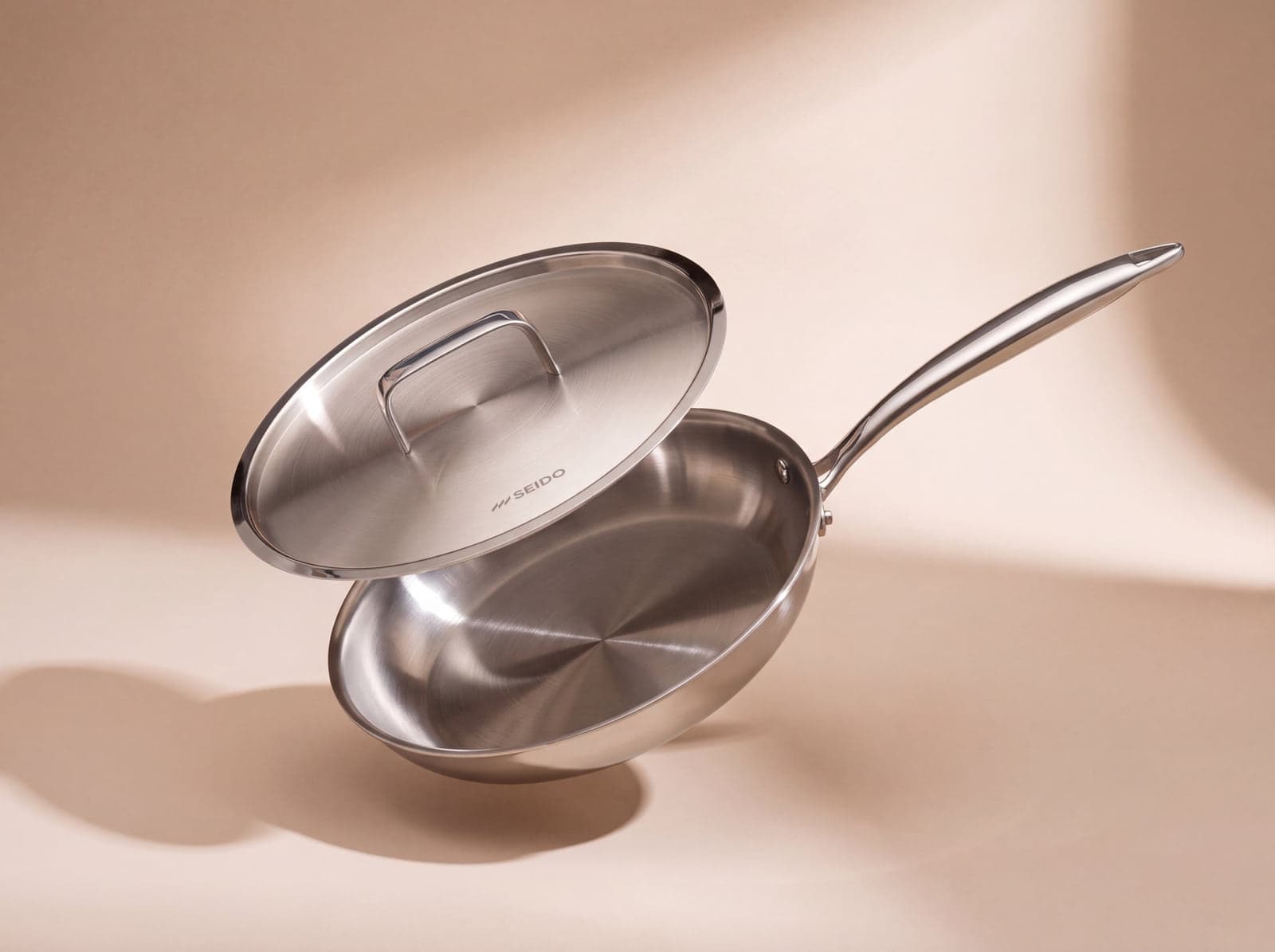
A frying pan for an induction hob needs a magnetic base, a flat bottom that sits in full contact with the glass and a base close in size to the cooking zone. A fridge magnet checks the first in seconds: if it clings firmly to the underside, an induction hob can heat the pan.
After that, choose as you would for any hob. A clad body — an aluminium core between layers of stainless steel — spreads the heat the hob creates in the base. Check the maker's stated hob compatibility, the size you cook in most and a weight you can lift comfortably, because on glass you lift a pan rather than slide it.
How does an induction hob heat a frying pan?
An induction hob has a coil under the glass that creates a rapidly switching magnetic field. That field induces electrical currents in a magnetic pan base, and the base itself becomes the source of heat. The glass warms only from the hot pan sitting on it.
That is why the base decides everything on induction. A pan whose base the field cannot work on stays cold, however good the rest of it is.
Which frying pans work on induction?
Only pans with a magnetic base. Cast iron, carbon steel and ferritic stainless steels such as 430 qualify. The 304 (18/8) grade used for cooking surfaces is austenitic, and in its normal state it is essentially non-magnetic, so a pan made entirely of 304 will not heat on induction. Aluminium, copper and glass pans do not work either, unless a magnetic plate is fixed to the base.
Clad frying pans designed for induction solve this at the outer layer. The cooking surface stays 304 for its corrosion resistance; the layer facing the hob is a magnetic grade such as 430, and that is the layer the hob heats.
How do you test a frying pan for induction?
The fridge-magnet test settles it for any pan you own. Hold an ordinary magnet to the underside. If it clings firmly, the base has a magnetic layer. If it slides off, an induction hob will not detect the pan.
The magnet reads the material only. A weak grip can mean poor performance, and how evenly a pan cooks on induction also depends on its flatness, its base diameter and the hob itself. When you are buying, look for the maker's own statement as well: the induction symbol on the base or packaging, or induction listed in the product details.
What else should you look for in an induction frying pan?
Once the base is magnetic, the rest of the choice is the same as for any good frying pan, with a few details that matter more on glass:
- A flat base. On induction and ceramic hobs, a base that rocks or bows leaves cool patches. Set the pan on a flat worktop and press on opposite sides of the rim: it should not rock.
- A clad body. An aluminium core between layers of stainless steel spreads the heat sideways from where the hob creates it, so the pan does not cook only over the coil.
- A base sized to your zones. Most hobs will not switch on for a base smaller than their minimum pan size, and a base much wider than the zone leaves a cooler outer band.
- A weight you can lift. On glass you lift a pan rather than slide it, so a frying pan that is comfortable to lift when full is one you will look after.
- A fitted lid. A lid lets you steam, braise and keep food warm; check its own care instructions, because a lid often has different limits from the pan.
What size frying pan suits an induction zone?
Match the base, not the rim, to the zone you use most. Measure the zone's marked circle and the flat underside of the pan: the closer the two are in diameter, the more evenly the pan heats. Your hob's manual gives the smallest pan each zone accepts.
For everyday cooking for one or two, a 24 cm (9.5 in) frying pan is a practical first size; for three or more servings, a 28 cm (11 in); for eggs and single portions on a small zone, a 20 cm (8 in). Remember that frying pans are sized by the rim, so the flat base that meets the glass is always smaller than the label.
Will an induction frying pan also work on gas and ceramic hobs?
A frying pan with a flat, magnetic base can cook on gas and ceramic hobs too; it is the reverse that is not guaranteed. Gas is the least demanding hob: the base does not need to be magnetic or perfectly flat, because the flame reaches it directly. Keep the flame under the base rather than climbing the sides, which heats the walls and the handle and leaves heat tint on the outside of the pan.
A ceramic hob heats the pan through the glass, so heat moves best where the base sits flat against it. Size the pan to the ring, and remember that radiant rings stay hot after you switch them off: to stop cooking quickly, move the pan off the ring.
How do you look after a frying pan on an induction hob?
Induction changes timing more than technique. A few habits keep both the pan and the glass in good shape:
- Preheat on a medium setting and stay with the pan. Heat builds very quickly on induction, and an empty frying pan on a high setting can overheat in moments.
- Lift the pan; do not slide it. Grit trapped under a moving base is what scratches the glass.
- Wipe the base before it goes on the hob. Burnt residue under the pan can mark the glass.
- Expect a faint hum at high power. It is common with clad pans and usually fades when you turn the setting down.
- Let the pan cool before it meets water. The sudden temperature change can warp a base, and a warped base loses contact with the glass.
Do SEIDO frying pans work on induction hobs?
Yes. All three SEIDO frying pans — 20 cm (8 in), 24 cm (9.5 in) and 28 cm (11 in) — work on gas, electric, ceramic and induction hobs. Each has a tri-ply clad body: a 304 (18/8) stainless steel cooking surface, an aluminium core and a magnetic 430 stainless steel exterior.
The cooking surface is uncoated, made without intentionally added PFAS and without synthetic coatings. Each pan is sold with a matching stainless steel lid and carries a 5-Year Limited Warranty. The 24 cm (9.5 in) is a practical first size for everyday cooking for one or two. Buy now on Amazon.
Cooking this way is what our 24 cm frying pan is built for.
Frequently asked questions
- How can I tell if a frying pan will work on induction?
- Hold a fridge magnet to the underside of the pan. If it clings firmly, the base contains a magnetic layer that an induction hob can heat. If it slides off, the base is non-magnetic and the hob will not detect it. The test reads the material, not how evenly the pan will cook, so check the maker's stated hob compatibility too.
- Why doesn't my stainless steel pan work on induction?
- Its base is probably non-magnetic. 304 (18/8) stainless steel has an austenitic structure, which its nickel content stabilises, and that structure is essentially non-magnetic. Induction-ready clad pans pair a 304 cooking surface with a magnetic stainless steel exterior, such as 430.
- Do you need special frying pans for an induction hob?
- You need a frying pan with a magnetic base. Cast iron, carbon steel and many clad stainless steel pans already have one; pure aluminium, copper and glass pans do not, unless a magnetic plate is fixed to the base. The fridge-magnet test tells you which of your pans will work.
- Can a frying pan be too small for an induction zone?
- Yes. Most induction hobs will not switch on for a base smaller than their minimum pan size. Check the manual for each zone's minimum, and cook on a zone close in size to the pan's base.
- Will a stainless steel frying pan scratch an induction hob?
- A clean stainless steel base that is lifted, not dragged, is unlikely to scratch glass-ceramic. Scratches usually come from grit or burnt residue trapped under a pan that slides across the surface, or from rough-bottomed cookware. Wipe the base before cooking and set the pan down gently.
- Do SEIDO frying pans work on induction?
- Yes. All three sizes — 20 cm (8 in), 24 cm (9.5 in) and 28 cm (11 in) — work on induction, as well as on gas, electric and ceramic hobs. Each has a tri-ply clad body with a 304 (18/8) stainless steel cooking surface and a magnetic 430 stainless steel exterior.
Browse all stainless steel frying pans or keep reading: Can You Cook Acidic Foods in Stainless Steel? · Can You Put a Stainless Steel Pan in the Oven? · How Hot Should a Stainless Steel Pan Be?.
SEIDO 24 cm Stainless Steel Frying Pan
See the 24 cm frying pan