The Complete Guide to Induction Cooking: How It Works and How to Cook on It
Published 20 August 2025 · Updated 12 October 2026
An induction hob heats the pan, not the glass. A coil beneath the glass creates a rapidly switching magnetic field that induces electrical currents in a magnetic pan base, so the base itself becomes the source of heat. Only pans with a magnetic base work, and a fridge magnet confirms one in seconds.
Cooking on induction changes timing more than technique. Heat builds quickly and answers within seconds when you change the setting, so preheat on a medium setting, stay with the pan and save the highest settings for bringing water to the boil.
How does induction cooking work?
Every hob gets heat into a pan by a different route. A gas hob heats the base with hot combustion gases. A ceramic hob has an electric element under a glass-ceramic plate; the plate gets hot, and heat passes into the pan wherever the base touches it. An induction hob has a coil under the glass that creates a rapidly switching magnetic field. That field induces electrical currents in a magnetic base, and the base itself becomes the source of heat.
Because the heat is made in the pan, the glass around it stays far cooler than a ceramic hob's would. The glass directly under the pan still gets hot from the pan itself, so treat a zone as hot for a while after cooking; most hobs show a residual-heat warning until it has cooled.
Which pans work on an induction hob?
Induction needs a magnetic base. Cast iron, carbon steel and ferritic stainless steels such as 430 work. The 304 (18/8) grade used for cooking surfaces is essentially non-magnetic, so a pan made entirely of 304 will not heat, and pure aluminium, copper and glass pans will not work unless a magnetic plate is fixed to the base.
Clad stainless pans made for induction use a magnetic outer layer, such as 430, with the 304 cooking surface inside. To check any pan, hold a fridge magnet to the underside: if it clings firmly, the hob can heat it; if it slides off, the hob will not detect it. The magnet reads the material only — how evenly the pan cooks depends on its flatness, its base size and the hob.
How do you preheat a pan on induction?
Heat builds very quickly, so an empty pan on a high setting can overheat in moments. Preheat a frying pan on a medium setting and stay with it.
The water test tells you when it is ready. Flick a few drops of water into the dry pan: when they bead and glide instead of hissing away, the surface is hot enough for food to release. Induction gets there sooner than a ceramic hob, so start checking early.
Which induction settings should you use?
Hobs number their settings differently, so learn yours by watching the pan rather than the dial. As a starting point:
- Low settings: melting butter, keeping a sauce warm, gentle simmering.
- Medium settings: preheating a frying pan, frying, sautéing and most everyday cooking.
- High settings: bringing liquid to the boil and quick reductions, with liquid in the pan.
- Boost, where your hob has it: a pan of water for pasta or vegetables — never an empty frying pan.
How quickly does induction respond when you turn it down?
Within seconds. Gas and induction both respond almost at once when you change the setting, while a ceramic ring keeps heating for a while after you turn it down. On induction you can sear and then drop straight to a simmer, and a sauce that is about to catch calms as soon as you lower the setting.
The pan itself still holds heat, so a heavy pan takes a moment to settle at the new setting. If something is about to burn, lift the pan off the zone.
Why does an induction hob hum, buzz or click?
Some sound is normal. A faint hum at high power is common with clad pans and usually fades when you turn the setting down. Pans made of several bonded layers can buzz more than single-layer ones, and a light pan or a lid can rattle at high settings.
At low settings, many hobs pulse the power on and off, which can make a soft clicking sound. A cooling fan protects the electronics, and it may keep running for a while after you switch off.
If a pan is unusually loud, check that its base sits flat and that it is centred on the zone.
Why won't an induction hob detect a pan?
An induction hob only switches on when it detects a suitable pan, so a hob that flashes or switches itself off usually means one of three things: the base is not magnetic, the base is smaller than the zone's minimum pan size, or the pan is off-centre.
Run the fridge-magnet test, move the pan to a smaller zone, or centre it on the marked circle. Your hob's manual lists the smallest pan each zone accepts.
How do you look after an induction hob and your pans?
Most care is the same as on any hob: let a pan cool before it meets water, wash it with washing-up liquid and a soft sponge, and dry it. A few habits are specific to glass:
- Lift the pan; do not slide it. Grit trapped under a moving base is what scratches glass-ceramic.
- Wipe the base before it goes on the hob. Burnt residue under the pan can mark the glass.
- Set the pan down gently. The weight of a frying pan is not the risk; a dropped pan is.
- Clean sugary spills promptly, following your hob maker's instructions. Sugar left to cool on glass-ceramic can pit the surface.
- Do not plunge a hot pan into cold water. The sudden temperature change can warp a base, and a warped base loses contact with the glass.
Will your SEIDO frying pan work on induction?
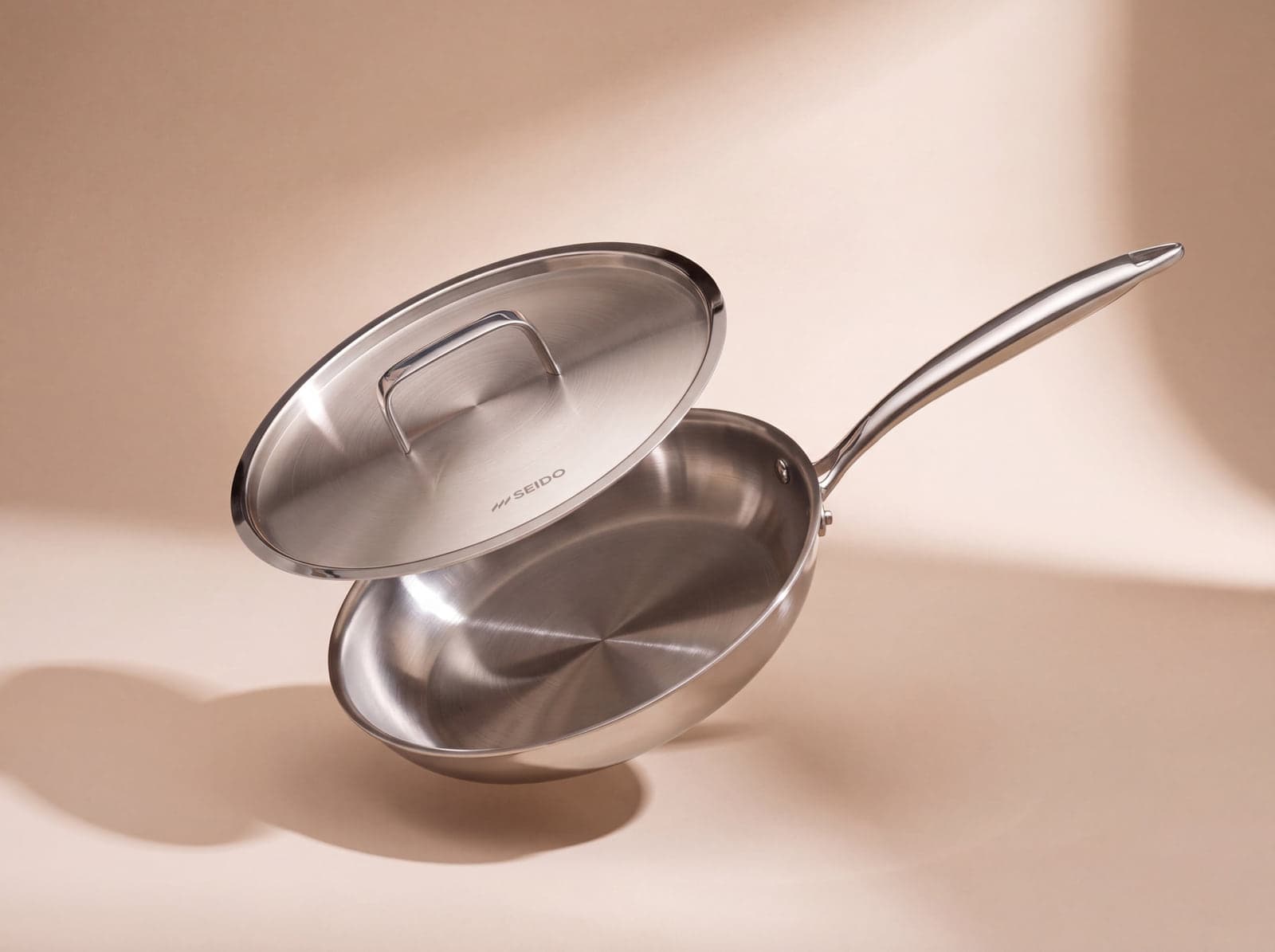
Yes. All three SEIDO frying pans — 20 cm (8 in), 24 cm (9.5 in) and 28 cm (11 in) — work on induction, as well as on gas, electric and ceramic hobs. Each has a tri-ply clad body: a 304 (18/8) stainless steel cooking surface, an aluminium core and a magnetic 430 stainless steel exterior, and each comes with a matching stainless steel lid.
The cooking surface is uncoated, made without intentionally added PFAS and without synthetic coatings, and every pan carries a 5-Year Limited Warranty. If you are setting up an induction kitchen, the 24 cm (9.5 in) is a practical first size for everyday cooking for one or two.
Cooking this way is what our 24 cm frying pan is built for.
Frequently asked questions
- Does an induction hob get hot?
- The hob makes heat in the pan, not in the glass, so the glass around the pan stays far cooler than on a ceramic hob. The glass under the pan does get hot from the pan itself, so treat the zone as hot for a while after cooking.
- What pans can you use on an induction hob?
- Any pan with a magnetic base: cast iron, carbon steel and stainless steel pans with a magnetic layer such as 430. Pure aluminium, copper and glass pans, and pans made entirely of 304 stainless steel, will not work unless a magnetic plate is fixed to the base. A fridge magnet that clings firmly to the underside confirms a pan will heat.
- Why is my induction hob buzzing?
- A faint hum or buzz at high power is common, especially with clad pans made of several bonded layers, and it usually fades when you turn the setting down. Clicking at low settings is the hob pulsing its power, and a fan may run to cool the electronics. Check that the pan sits flat and centred on the zone.
- Why won't my induction hob detect my pan?
- The base is probably not magnetic, smaller than the zone's minimum pan size, or off-centre. Hold a fridge magnet to the underside, try a smaller zone, and centre the pan on the marked circle.
- Can you use cast iron on an induction hob?
- Yes. Cast iron is magnetic, so induction heats it. It is heavy and can have a rough base, so lift it rather than sliding it, and set it down gently to protect the glass.
- Do you need new pans for an induction hob?
- Not necessarily. Run the fridge-magnet test on the pans you already own: any pan whose base the magnet clings to firmly will heat. You only need to replace the ones that fail, such as pure aluminium, copper or glass pans.
Browse all stainless steel frying pans or keep reading: Can You Cook Acidic Foods in Stainless Steel? · Can You Put a Stainless Steel Pan in the Oven? · How Hot Should a Stainless Steel Pan Be?.
SEIDO 24 cm Stainless Steel Frying Pan
See the 24 cm frying pan