5-Ply or Tri-Ply? How to Read the Ply and Steel Grade Claims on a Pan Listing
Published 22 June 2025 · Updated 12 October 2026
A ply number counts the metal layers bonded together in a pan, and nothing more. It does not tell you how thick the heat-spreading core is, whether the layers run up the walls or sit only in the base, how well they are bonded, or which grade of steel touches your food. Read those details beside the number.
The same goes for steel grades and test results. A grade such as 304 (18/8) describes a material, and a certificate or test proves something only about the item that was tested. Ask one question of every line on a listing: what exactly does this describe — the body, the base, the cooking surface or one part?
What does the ply number on a listing count?
Ply is the count of metal layers bonded together. On a clad pan, stainless steel sits on the outside faces and a more conductive metal, usually aluminium, sits in the middle. Aluminium spreads heat well, and stainless steel gives a durable cooking surface.
Tri-ply, or 3-ply, is steel, aluminium, steel. 5-ply usually adds two more layers, often alternating steel and aluminium, and 7-ply and higher counts divide the stack further. The number tells you how many layers there are. It does not tell you how much of each there is.
What doesn't a ply number tell you?
Two pans can both say 5-ply and behave completely differently, because the count leaves out most of what decides how a pan cooks. These are the gaps a ply number leaves:
- How thick the core is. The aluminium does the heat spreading, so its total thickness matters more than how many layers it is split into. A tri-ply pan with a thick core can outperform a 5-ply pan with thin ones.
- Where the layers run: through the whole body, or only in a disc under the base.
- How well the layers are bonded. A poorly bonded pan can separate at the base, whatever its count.
- What the layers are made of. A count without materials says little about the cooking surface or the outside of the pan.
- How much the pan weighs. Across pans of the same diameter, weight is a rough guide to how much metal, and how much stored heat, there is.
Is it a 5-ply body or a 5-layer base?
'5-ply' and '5-layer base' are not the same claim. The first should mean the layers run through the whole pan, base and walls. The second can mean a layered disc fixed to an otherwise single-layer body.
Fully clad construction runs the layers up the walls. An encapsulated or disc base puts the extra metal only on the bottom. A good listing says which one it is, with words such as 'fully clad' or 'clad through the sides'. If a listing only describes the base, assume the walls are single-layer steel.
Thickness figures have the same catch. Thickness is usually given in millimetres, or as a gauge number for sheet metal, where a higher gauge means thinner metal. Check whether the figure describes the base or the wall: on a disc-base pan the two can differ a lot.
What do the steel grade numbers on a listing mean?
Grade numbers describe what the steel is made of. Type 304 is the most common austenitic stainless steel used for food contact. It is often written as 18/8, which means roughly 18% chromium and 8% nickel by weight.
Chromium is what makes stainless steel stainless: it reacts with oxygen to form a very thin, stable oxide film that resists corrosion and re-forms if the surface is scratched. Nickel keeps the steel in its austenitic structure, which gives 304 its toughness and formability and makes it essentially non-magnetic in its annealed state.
18/10 means the same family of steel with about 10% nickel. Both are sold under the 304 designation, because the standard allows a nickel range. The ratio on a label should match the ratio on the mill paperwork: if a listing says 18/10 and the certificate reads 8% nickel, the listing is wrong.
- 304 or 18/8: about 18% chromium and 8% nickel, non-magnetic when annealed
- 18/10: the same family, with about 10% nickel
- 430 or 18/0: about 16 to 18% chromium, little or no nickel, magnetic
- 'Surgical grade': a marketing phrase, not a standard grade designation
Which layer of the pan does the grade describe?
On a clad pan, each layer can be a different metal, so a single grade on a listing describes one layer, not the whole pan. The layer that touches food is the one that matters for food contact, and 304 (18/8) is the grade to look for there.
The outside is often a different steel. Induction hobs need a magnetic base to work, and 304 is largely non-magnetic, so many clad pans use a magnetic grade such as 430 on the outside; that is where the induction property usually comes from. Check the maker's stated hob compatibility rather than inferring it from a grade.
A listing that names only one grade for a clad pan has told you about one layer. A useful listing names the cooking surface, the core and the exterior.
What does a mill certificate prove, and what doesn't it?
A mill certificate is issued by the steel mill for a batch, or heat, of metal. It lists the measured chemical composition and usually mechanical properties such as tensile strength and hardness. It is good evidence of what the raw sheet is made of.
It does not describe the finished pan. It says nothing about how the layers were bonded, how the handle was fixed or how the pan behaves in an oven. Any heat figure on it refers to the sheet under the mill's test conditions, not to a pan with a handle, rivets and a lid.
It also covers only the heat it names. A certificate for one blank size does not automatically cover a different blank or a different production run. When a brand shows one, check that the product, size and batch line up.
Which cookware claims should you question?
Some phrases appear on listings without any test behind them. They are not always false, but they are claims to question rather than accept. The useful habit is to ask what specimen was tested — the metal, the finished pan or one part — and under what conditions.
- A layer count with no materials and no core thickness
- A base construction described as if it were the whole pan
- Handles described as staying cool, with no measured handle temperature or time
- 'Surgical grade' with no grade number
- A nickel ratio on the label that differs from the mill certificate
- An oven temperature stated for a whole pan and lid when only the pan body was rated
- Warranty wording with no stated term or conditions
How does SEIDO describe its own frying pans?
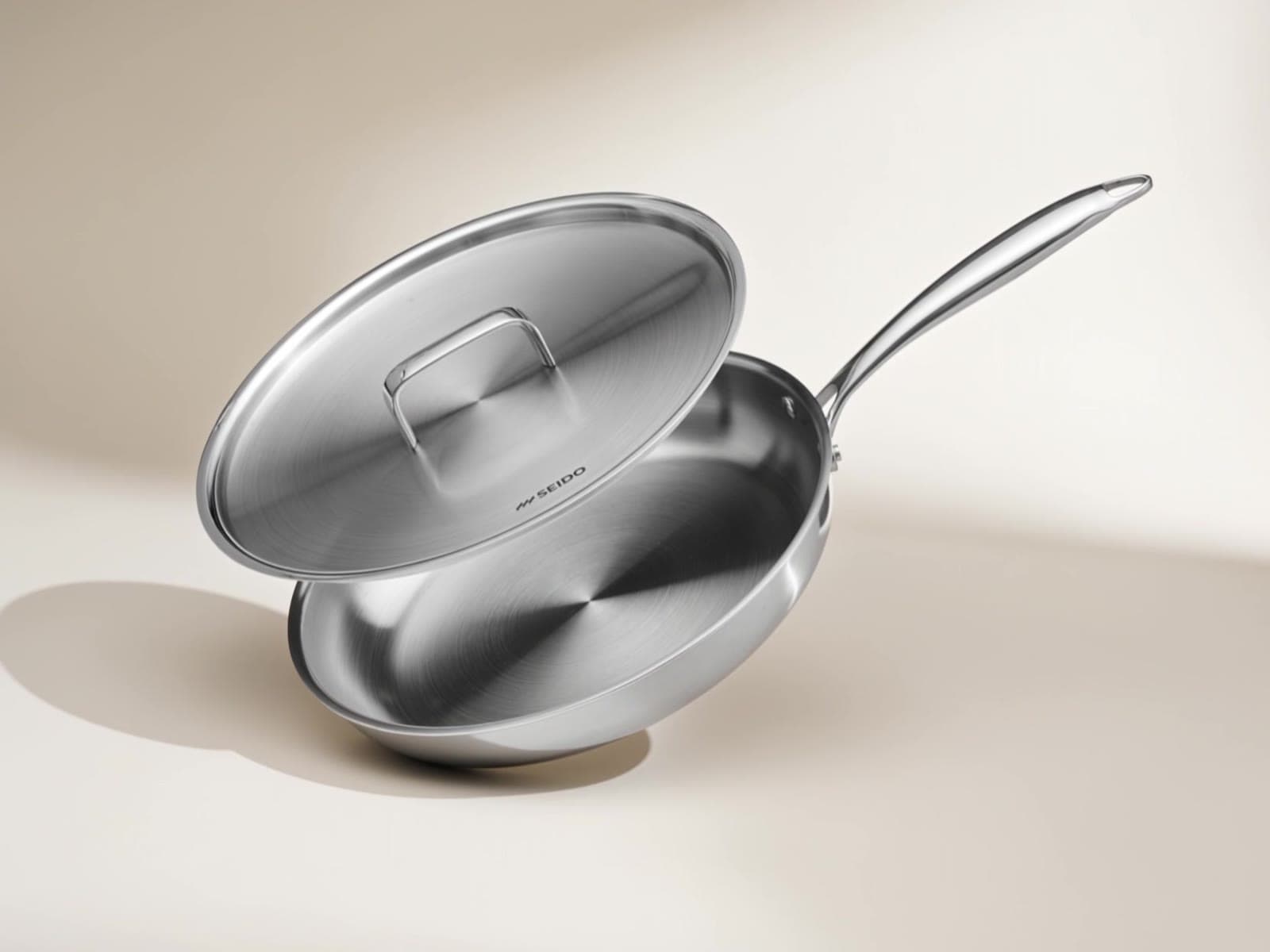
We write each claim with its scope beside it. Our frying pans have a tri-ply clad body: a 304 (18/8) stainless steel cooking surface, an aluminium core and a 430 stainless steel exterior. The cooking surface is uncoated and made without intentionally added PFAS. The pans work on gas, electric, ceramic and induction hobs, come in 20 cm (8 in), 24 cm (9.5 in) and 28 cm (11 in), and each is backed by a 5-Year Limited Warranty.
The oven rating carries its scope on the same line: oven-safe to 260°C (500°F) for up to 1 hour. It covers the pan body, handle and lid. Our lunch box container's oven rating likewise names the container alone, because it was lab-tested without its lid. Where a claim is not yet backed by a document, it stays off the page.
Cooking this way is what our 24 cm frying pan is built for.
Frequently asked questions
- What does 5-ply mean on a frying pan listing?
- It means five metal layers are bonded together, usually stainless steel on the outside faces with aluminium inside. On its own it does not tell you how thick the core is, whether the layers run up the walls, or which grade of steel the cooking surface is.
- Is a 5-layer base the same as a 5-ply pan?
- No. A 5-ply pan should have five layers through the whole body, walls included. A 5-layer base can be a layered disc fixed under an otherwise single-layer body. If you want the layers in the walls, look for 'fully clad' or 'clad through the sides' in the description.
- How can you tell how much metal is in a pan from its listing?
- Look for two figures: core thickness and total weight. Core thickness, in millimetres, tells you how much heat-spreading metal sits inside. Weight compared across pans of the same diameter is a rough guide to stored heat. If a listing gives neither, the layer count alone cannot tell you.
- What does 18/8 on a listing actually tell you?
- 18/8 tells you the steel is type 304, with roughly 18% chromium and 8% nickel by weight. It describes the material only — and on a clad pan, usually only one layer. It does not tell you how the finished pan was made or how it performs, which is what finished-product tests cover.
- What does a mill certificate prove?
- A mill certificate proves the measured chemical composition and mechanical properties of a specific batch of steel. It does not prove how a finished pan performs, and it only covers the batch and blank it names.
- How can I tell if a cookware claim has really been tested?
- Look for a named test standard or report, a stated specimen and the test conditions, such as temperature, time, cycles and whether the lid was included. A claim with none of these attached is a statement, not a test result.
Browse all stainless steel frying pans or keep reading: Can You Cook Acidic Foods in Stainless Steel? · Can You Put a Stainless Steel Pan in the Oven? · How Hot Should a Stainless Steel Pan Be?.
SEIDO 24 cm Stainless Steel Frying Pan
See the 24 cm frying pan