Honing vs Sharpening a Stainless Steel Knife: What Each Does and When
Published 10 February 2026 · Updated 12 October 2026
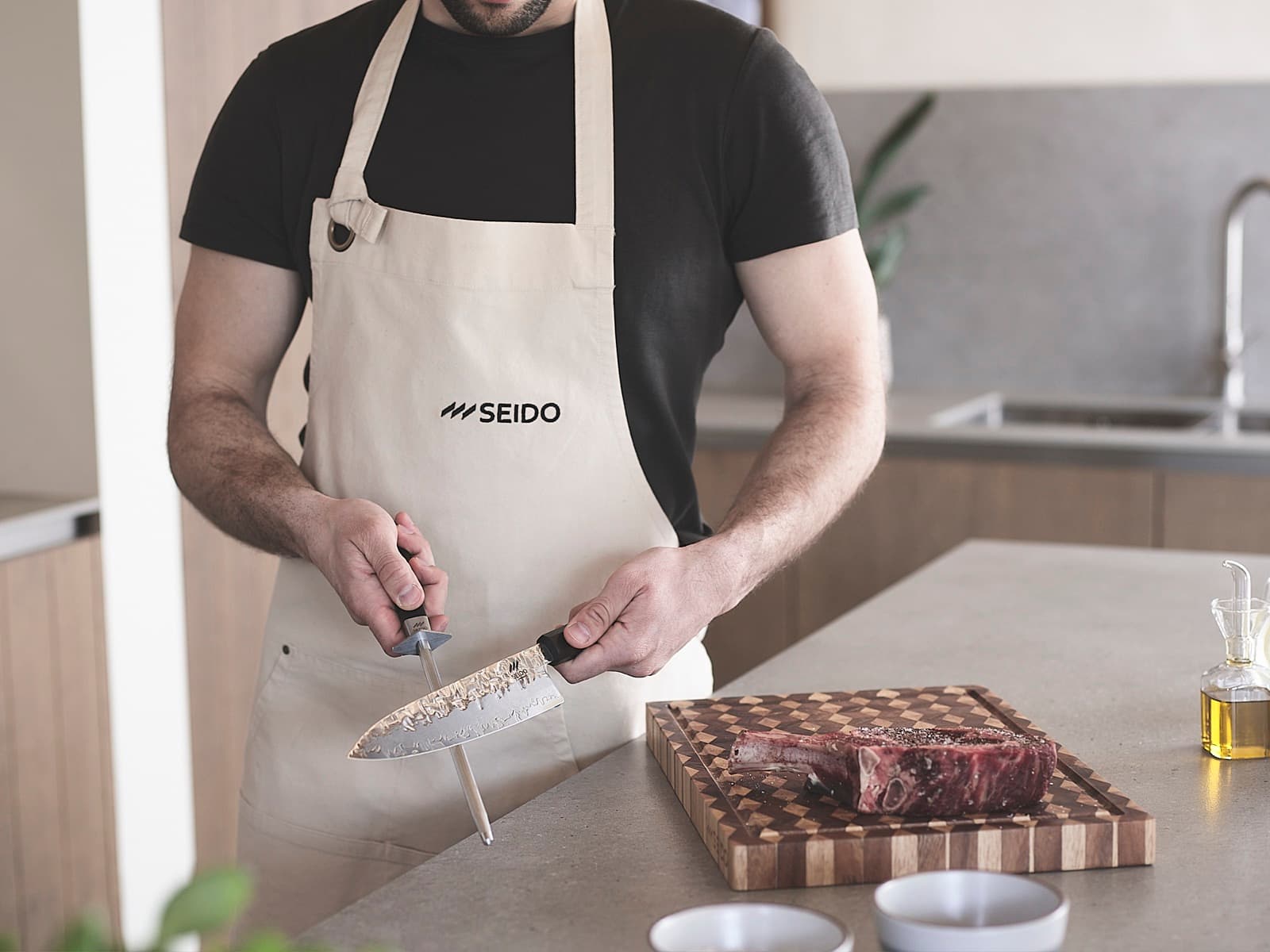
Honing and sharpening are different jobs. Honing pushes a knife edge that has rolled out of line with use back into line, removing little or no metal. Sharpening grinds away metal to form a new edge, and is needed only when honing no longer brings back a clean cut. Hone little and often; sharpen occasionally.
This guide explains what happens to an edge as you cook, how to hone step by step, how often to do it, how to tell when honing is no longer enough and how sharpening works. It applies to plain-edged stainless steel kitchen knives; serrated knives, such as bread knives, need a different tool.
What happens to a knife edge as you cook?
A sharp edge is a very fine strip of steel where the two sides of the blade meet. Every cut presses it against the board and through the food, and over time the thinnest part bends a little to one side. Cooks say the edge has rolled.
A rolled edge meets the food at an angle instead of head on, so the knife feels blunt: it slides on a tomato skin, bruises herbs and needs more pressure. The steel is still there, only out of line, and honing puts it back.
Over a longer time the edge also wears: tiny amounts of steel are lost and the very edge becomes rounded. That is true bluntness, and only sharpening fixes it.
What is the difference between honing and sharpening?
Honing maintains an edge; sharpening replaces it.
- Honing straightens a rolled edge. It removes little or no metal, takes a few seconds and is done often.
- Sharpening grinds a new edge. It removes metal, takes longer and is done occasionally — when honing stops working.
- Honing uses a honing steel: a rod on a handle, drawn along the edge in light strokes.
- Sharpening uses a whetstone, a sharpener or a sharpening service.
Why are honing steels sold as sharpeners?
Shops blur the two jobs: honing steels are often sold as knife sharpeners or sharpening steels. The names overlap; the jobs do not. A honing steel looks after an edge between sharpenings, and it cannot bring back an edge that has worn away.
Some rods do a little of both. Ceramic and diamond-coated rods are abrasive, so they remove a small amount of metal as they realign, while a plain steel rod mainly realigns. Whatever the rod, the technique is the same: light strokes at the angle of the edge.
How do you hone a knife, step by step?
The safest way to learn is with the rod standing upright and still, its tip resting on a board. Speed comes with practice and is not the point.
- Stand the honing steel upright with its tip on a chopping board or a folded cloth so it cannot slip. Hold the handle firmly, with your hand behind the guard.
- Find the angle. Look at the narrow bevel along the edge of the blade and tilt the knife until that bevel sits roughly flat against the rod. It is a shallow angle, with the blade much closer to the rod than to a right angle.
- Set the heel of the blade, the end nearest the handle, against the rod near the top.
- Draw the knife down the rod and towards you in one light, smooth stroke, so the whole edge passes the rod from heel to tip by the time you reach the bottom.
- Repeat on the other side of the rod for the other face of the blade, alternating sides.
- A few strokes per side are enough, finishing with the lightest. Pressure does not help: honing is about alignment, not force.
- Wipe the blade with a clean cloth before you start cooking.
How often should you hone a knife?
Little and often. For the SEIDO Cookware chef's knife, the insert that comes with it recommends honing every 2–3 uses; a few strokes per side before you start cooking is an easy way to keep to that.
Light, regular honing keeps a sharp knife cutting cleanly for longer between sharpenings. Heavy, occasional honing does the opposite: pressing hard or honing at a steep angle can damage a fine edge.
How do you know when a knife needs sharpening?
When honing no longer brings back a clean cut, the edge has worn rather than rolled. How soon that happens depends on how much you cook, what you cut and what you cut on: glass, stone and ceramic surfaces wear an edge quickly. For many home cooks, sharpening is an occasional job rather than a routine one, so let the knife tell you, not the calendar.
Three quick checks tell you when it is time:
- The tomato test: a sharp, aligned edge bites into the skin of a ripe tomato with almost no pressure. If the knife slides or squashes it straight after honing, it needs sharpening.
- The paper test: hold a sheet of paper by one corner and slice down through it. A sharp edge cuts cleanly; a worn one snags or tears.
- The light test: look straight down at the edge under a bright light. A sharp edge shows almost no reflection; a worn or rounded edge shows a thin bright line or bright spots.
How do you sharpen a knife?
There are three common routes. Whichever you use, finish with a light hone to align the fresh edge, then wash and dry the blade.
- A whetstone: wet the stone as its maker directs, hold the blade at its edge angle and work one side until a slight burr — a fine lip of metal — forms along the whole edge on the other side, then repeat on the second side. Remove the burr with lighter, alternating strokes and finish on a finer grit. It takes practice, and gives you the most control.
- A pull-through sharpener: quick and simple. Its fixed angle may not match every knife, and a coarse one removes more metal than needed, so use it gently.
- A sharpening service: many cutlers and kitchen shops offer one. It is a sound choice for a knife you value, or if you would rather not learn to use a stone.
Keeping an edge this way is what our honing steel is built for.
Frequently asked questions
- What is the difference between honing and sharpening?
- Honing realigns a knife edge that has rolled out of line with use; it removes little or no metal and takes seconds. Sharpening grinds away metal to form a new edge, on a whetstone, with a sharpener or at a sharpening service. Hone little and often, and sharpen when honing no longer brings back a clean cut.
- Why is my knife still blunt after honing?
- Because the edge has worn rather than rolled. Honing can only straighten steel that is still there; once the edge is rounded or nicked, it needs sharpening. If the knife still slides on a ripe tomato straight after honing, sharpen it on a whetstone or take it to a sharpening service.
- Can honing damage a knife?
- Light strokes at roughly the angle of the edge do not. Heavy pressure, a steep angle or knocking the edge against the rod can bend or chip a fine edge. Keep the rod still, the strokes light and the angle shallow, and finish with the gentlest strokes.
- Should you hone a knife before or after using it?
- Before is the easier habit: a few strokes per side as you start cooking, so the knife begins with a straight edge. For the SEIDO Cookware chef's knife, the insert that comes with it recommends honing every 2–3 uses. A light hone straight after sharpening helps as well.
- Can you hone a serrated knife?
- Not in the usual way. A honing steel is for plain edges. The teeth of a serrated knife, such as a bread knife, sit in scallops that a straight stroke along a rod cannot follow, so serrated knives are sharpened scallop by scallop with a tapered rod, or by a sharpening service.
Browse all kitchen tools or keep reading: Damascus Chef's Knife Care Guide · Honing Steel Care Guide · Serrated Peeler Care Guide.
SEIDO 20 cm Honing Steel
See the honing steel