Chef's Knife Size Guide: Which Blade Length Do You Need?
Published 5 February 2026 · Updated 12 October 2026
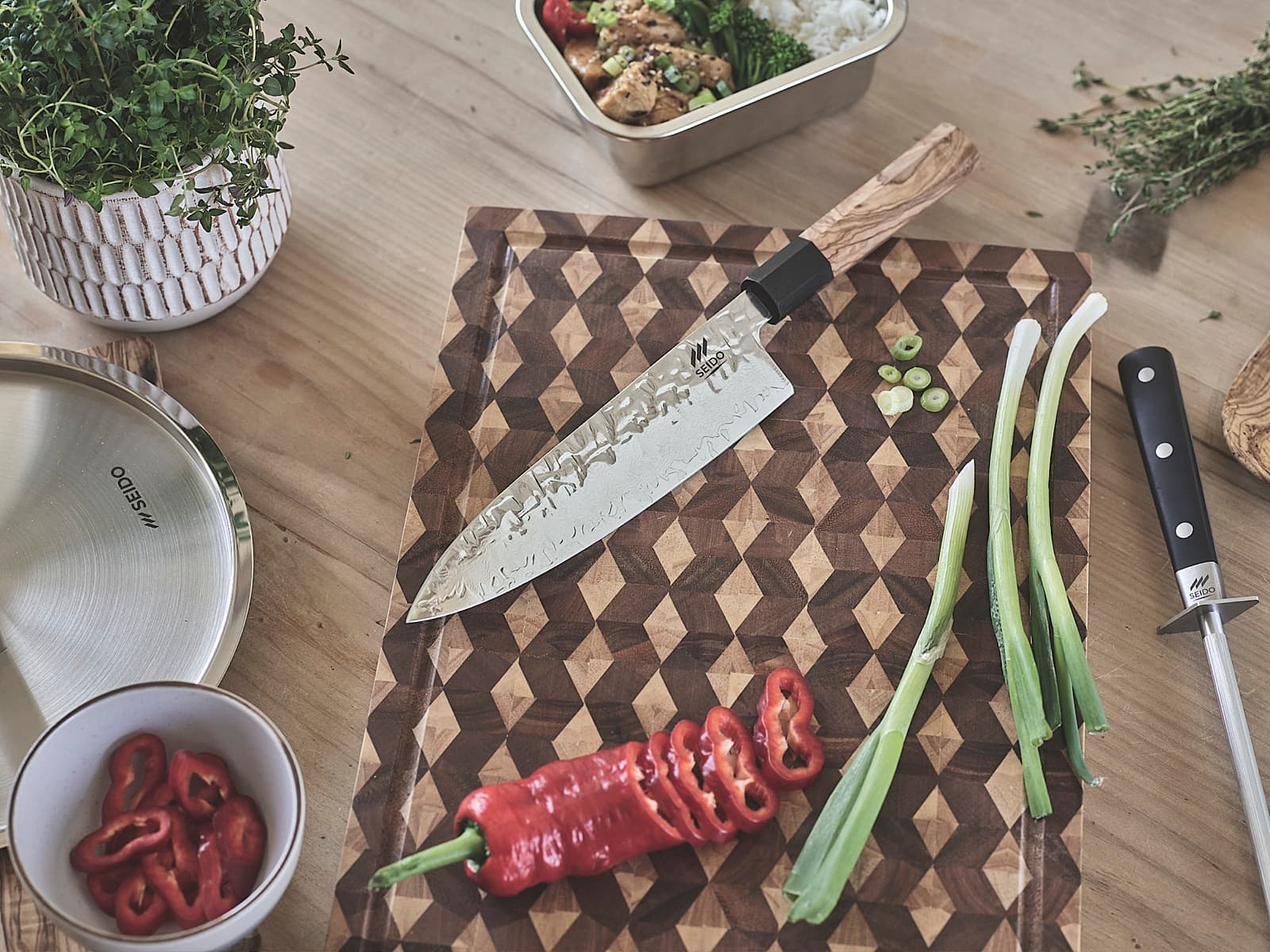
Most home cooks are best served by a chef's knife with a blade of about 20 cm (8 in), the size class sold as an eight-inch chef's knife. A 15 cm (6 in) blade suits small kitchens, small boards and lighter jobs; a 25 cm (10 in) blade suits large boards, big batches and confident hands.
This guide explains how blade length is measured, what each common size is for, how to match a size to your board and your cooking, and how long the other everyday knives usually are. The SEIDO Cookware chef's knife has a blade of about 22 cm (8.7 in): an eight-inch chef's knife by size class.
How is a chef's knife blade measured?
Blade length is measured in a straight line from the tip to the heel — the end of the blade where it meets the handle. The handle is not included, so a knife is always longer overall than its size suggests.
Sizes are classes, not exact measurements. Chef's knives are sold in steps, in centimetres or in inches, and makers measure slightly differently — some to the front of the handle, some along the cutting edge alone — so two knives sold at the same size can differ by a centimetre or more. A knife sold as an eight-inch chef's knife may measure a little more or a little less than 20 cm.
What are the common chef's knife sizes?
Chef's knives come in four common size classes. Some ranges add in-between lengths, and the same logic applies to them: a shorter blade is nimbler, a longer one covers more ground with each stroke.
The four classes, with their usual rounded centimetre equivalents:
- 15 cm (6 in), a six-inch chef's knife — compact and nimble. It suits small kitchens and boards, lighter jobs and cooks who find a longer blade unwieldy, but it takes more strokes through large vegetables and big cuts of meat.
- 20 cm (8 in), an eight-inch chef's knife — the all-purpose size. Long enough to slice through a large onion or a chicken breast in one stroke, short enough to control on an ordinary board.
- 25 cm (10 in), a ten-inch chef's knife — for large boards, big produce such as cabbages and squash, large joints of meat and cooking in quantity. The extra length needs room and a confident technique.
- 30 cm (12 in), a twelve-inch chef's knife — rare in home kitchens. It is a tool for very large boards and prep in large volumes.
Which chef's knife size suits you?
Five things decide it:
- Your chopping board — the board should be clearly longer than the blade, with room to push cut food aside. A small board and a long knife are an awkward match: choose a shorter blade or a bigger board.
- What you cook — herbs, garlic, shallots and small vegetables suit a shorter blade; large produce, joints of meat and family-sized batches suit a longer one. Most everyday cooking sits comfortably at 20 cm (8 in).
- Your experience — a longer blade covers more ground per stroke but asks for a steadier technique. If you are building confidence, 20 cm (8 in) or a little shorter is easier to control.
- Your hand and grip — hand size matters less than many people expect. In a pinch grip, many cooks with small hands use a 20 cm (8 in) knife comfortably; what matters more is a handle that feels secure.
- Your storage — check that your knife block slot, drawer organiser or magnetic strip takes the blade length.
Why is 20 cm (8 in) the usual starting size?
Because it does the most jobs without getting in the way. It is long enough for the rocking cut through a pile of herbs and for a single long slicing stroke through meat and fish, yet short enough for the tip to do fine work and for the whole blade to fit on a standard chopping board with room to spare.
If you will own only one chef's knife, this is the size most often recommended. Move down to 15 cm (6 in) if your kitchen, your board or your hand calls for it, or up to 25 cm (10 in) if you regularly cook in quantity on a large board.
Does blade height matter as well as length?
Yes. Height is the depth of the blade at the heel, from the spine to the edge. A taller blade gives your knuckles more clearance above the board as you cut, and a broad flat for scooping chopped food and crushing garlic. A slimmer blade is lighter and moves more easily through tall or dense food. Chef's knives of the same length can differ noticeably in height, so compare both.
What size are the other everyday knives?
For reference, these are the usual lengths of the knives that sit alongside a chef's knife:
- Paring knife — about 8–10 cm (3–4 in), for peeling, trimming and work held in the hand
- Utility knife — about 12–15 cm (5–6 in), for sandwiches, soft fruit and small vegetables
- Serrated bread knife — about 20–25 cm (8–10 in), long enough to cross a wide loaf
- Carving or slicing knife — about 20–30 cm (8–12 in), for long, even slices from roasts and joints
How long is the SEIDO Cookware chef's knife?
The SEIDO Cookware chef's knife has a blade of about 22 cm (8.7 in). By size class it is an eight-inch chef's knife, the all-purpose size described above.
The blade has a VG10 steel core clad in Damascus stainless steel, and the handle is octagonal olive wood. It comes in a hinged gift box, is hand wash only and carries a 5-Year Limited Warranty.
Cutting this way is what our chef's knife is built for.
Frequently asked questions
- What size chef's knife suits most home cooks?
- A blade of about 20 cm (8 in), sold as an eight-inch chef's knife, suits most home cooks: long enough for large vegetables and meat, short enough to control on an ordinary board. Choose 15 cm (6 in) for a small kitchen or board, and 25 cm (10 in) for large boards and cooking in quantity.
- Is a 20 cm chef's knife too big for small hands?
- Usually not. In a pinch grip — thumb and the side of the index finger on the blade just in front of the handle — the blade's length matters less than how the handle fits your hand. If a 20 cm (8 in) knife still feels unwieldy, a 15–18 cm (6–7 in) blade is a sensible step down.
- How long is an eight-inch chef's knife in centimetres?
- About 20 cm: eight inches is 20.3 cm. Size classes are rounded, though, and makers measure blades slightly differently, so a knife sold as an eight-inch chef's knife may measure a little more or less. The SEIDO Cookware chef's knife, for example, has a blade of about 22 cm (8.7 in).
- What size chopping board do you need for a chef's knife?
- One noticeably longer than the blade: the whole edge should rest on the board as you cut, with space beside it for food you have already chopped. The longer the knife, the larger the board it needs. Put a damp cloth or a non-slip mat underneath so the board cannot slide.
- Does a longer chef's knife cut better?
- Not in itself. A longer blade covers more ground per stroke, which helps with large produce, roasts and big batches; a shorter one is quicker and easier to control for small, detailed work. The right length is the one that suits your board, your cooking and your hand.
Browse all kitchen tools or keep reading: Damascus Chef's Knife Care Guide · Honing Steel Care Guide · Serrated Peeler Care Guide.
SEIDO Damascus Stainless Steel Chef's Knife
See the chef's knife