Frying Pan Size Guide: 20 cm vs 24 cm vs 28 cm
Published 28 January 2026 · Updated 12 October 2026
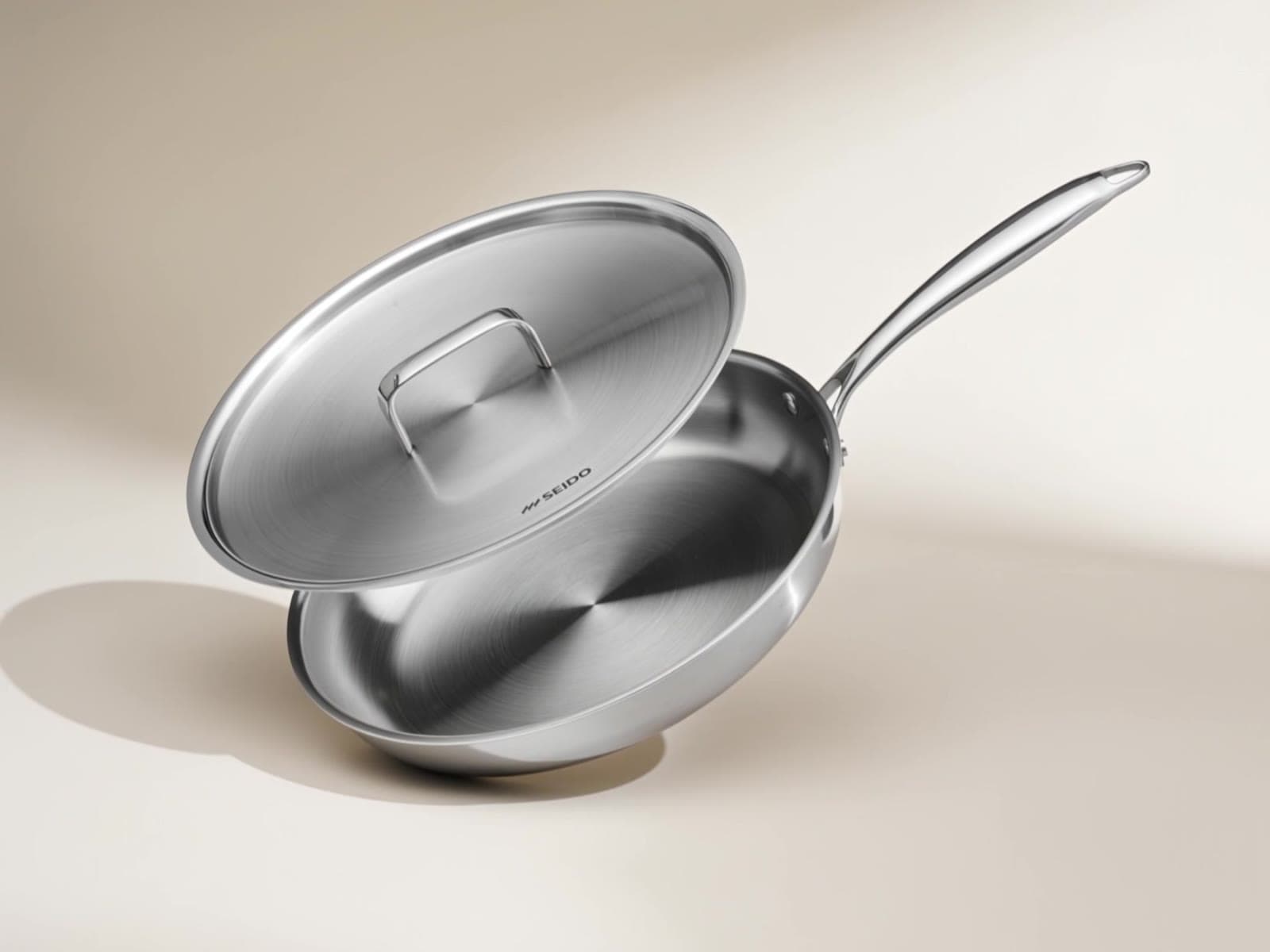
Frying pan sizes are measured across the rim, and the right size follows your servings. A 20 cm (8 in) pan suits one person and eggs. A 24 cm (9.5 in) pan handles everyday cooking for one or two. A 28 cm (11 in) pan fits three or more servings, batch cooking and larger cuts.
The flat cooking surface at the base is always smaller than the size on the label, because the walls slope outwards. Before you buy, measure the flat base of the pan you use most and your largest hob ring or cooking zone: a frying pan browns evenly when its base roughly matches the heat beneath it.
How are frying pan sizes measured?
Frying pans are labelled by rim diameter, measured straight across the top of the pan from outside edge to outside edge. It is the industry-standard way to size a pan, and it is the number to compare between brands.
The flat cooking surface at the base is always smaller, because frying pan walls slope outwards. How much smaller depends on how steeply the walls flare, which varies from brand to brand, so two pans with the same label can offer different cooking areas.
To measure a pan you already own, lay a ruler across the top from rim to rim for its size, then measure the flat inside of the base. The second number tells you how much food sits directly over the heat.
Frying pan size chart: what does each size do?
Here is the size map in plain terms. Sizes are rim diameters, with the imperial equivalent alongside.
Each step up adds more surface than the numbers suggest, because area grows with the square of the diameter. Measured at the rim, a 28 cm pan has nearly twice the area of a 20 cm pan, and over a third more than a 24 cm pan.
- 20 cm (8 in) — the single-serving pan. Typical use: fried eggs, an omelette, a toastie, toasting nuts and spices, reheating one portion. Servings: 1.
- 24 cm (9.5 in) — the everyday pan. Typical use: weeknight dinners, two pieces of meat or fish with room to sear, pan sauces, a hash, a stir-fry for two. Servings: 1–2.
- 28 cm (11 in) — the batch pan. Typical use: steaks seared side by side, one-pan dinners, browning for stews and casseroles, cooking for a full table. Servings: 3+.
How do you match a frying pan to your hob?
A frying pan browns evenly when its base roughly matches the ring or zone under it. A pan far wider than the heat runs cool at the edges; a pan far smaller than a gas flame wastes heat up the sides. Measure your largest ring or zone before you buy your largest pan.
Each type of hob adds its own detail. On gas, keep the flame under the base rather than climbing the walls. On a ceramic hob, heat passes into the pan where the base sits flat against the glass, so get the base and the ring as close in diameter as you can. On induction, the base must be magnetic, and most hobs will not switch on for a base smaller than their minimum pan size — the hob's manual gives the smallest pan each zone accepts.
Why does frying pan size change how food browns?
Size matters because of crowding. When food packs a pan too densely, it releases moisture faster than the heat can evaporate it. The pan's surface temperature drops, juices pool, and dinner steams instead of searing. No browning means no fond — the browned layer that builds flavour in the pan.
A frying pan with the right amount of open surface keeps its temperature up and lets moisture escape. Too big has a cost as well: oil spreads thin across the empty areas of a hot pan and can smoke before the food is done.
Shopping for a 26 cm frying pan?
A quick honest note: we do not make a 26 cm frying pan. Our sizes either side of it are the 24 cm (9.5 in) and the 28 cm (11 in). Whether that matters depends on what the 26 cm label was doing for you.
Because labelled sizes measure the rim, the usable cooking surface is set by the base and the wall slope, and wall slope varies from brand to brand. Compare the flat bases, not just the labels.
So decide by role, not by label. If a 26 cm pan was going to be your do-everything frying pan for one or two people, a 24 cm (9.5 in) pan covers that job. If you wanted it as the big pan for a household of three or more, step up to a 28 cm (11 in) instead — the extra surface is what prevents crowding when every serving goes in at once.
Shopping for a 30 cm frying pan?
Our largest frying pan is the 28 cm (11 in), and it is fair to say a 30 cm pan genuinely suits some households: four or more servings on a routine night, weekly batch cooking, or one-pan meals where everything cooks together. If that is your kitchen, a bigger pan is a legitimate choice.
But check your hob before you commit. A very wide pan only browns evenly when the ring or zone can drive its whole base. On a typical home hob, the edges of an oversized pan run cooler than the centre, which shows up as pale rings on pancakes and uneven colour on seared meat. If the edges of your current large pan already run cool, going wider will not fix dinner — it will just spread it thinner.
Measured at the rim, a 30 cm circle is roughly 15% larger than a 28 cm one. A 28 cm (11 in) frying pan already holds two steaks side by side without crowding. Measure your largest ring or zone and the flat base of the pan you own now, and let those two numbers, not the label, make the call.
Where do SEIDO frying pan sizes fit?
SEIDO frying pans come in exactly the three sizes this guide maps: 20 cm (8 in) for single servings, 24 cm (9.5 in) for everyday cooking for one or two, and 28 cm (11 in) for three or more servings and batch cooking. Each is sold with a matching stainless steel lid.
All three share one construction, so the choice really is size alone. Each frying pan is uncoated, with a tri-ply clad body: a 304 (18/8) stainless steel cooking surface, an aluminium core and a 430 stainless steel exterior. They are made without intentionally added PFAS and without synthetic coatings, work on gas, electric, ceramic and induction hobs, and carry a 5-Year Limited Warranty. SEIDO Cookware products are sold in the UK on Amazon.co.uk.
Cooking this way is what our 28 cm frying pan is built for.
Frequently asked questions
- Do frying pan sizes measure the rim or the base?
- The industry standard is rim diameter — measured straight across the top of the pan from outside edge to outside edge. The flat cooking surface at the base is always smaller, because frying pan walls slope outwards. That is why two pans with the same labelled size can have noticeably different cooking areas.
- How do you measure a frying pan?
- Lay a ruler or tape measure across the top of the pan, from the outside edge of the rim to the outside edge opposite: that is the size pans are labelled by. Then measure the flat inside of the base, which is always smaller and tells you how much food sits directly over the heat.
- 28 cm vs 30 cm frying pan: do 2 cm matter?
- Somewhat. Measured at the rim, a 30 cm circle is roughly 15% larger than a 28 cm circle. The flat base of each pan is smaller than the rim and wall slope varies by brand, so the real difference in cooking surface can be larger or smaller. A 30 cm pan also needs a wider ring or zone to heat its base evenly.
- Will a 28 cm frying pan work on a small hob ring?
- It will work, but the edges may run cooler if the ring or zone is much smaller than the pan's base. For even browning, cook on your largest ring or zone, and keep a smaller pan for the small ring.
- What size frying pan is best for eggs?
- A 20 cm (8 in) frying pan. Two or three eggs stay contained, so the whites hold together instead of spreading thin and overcooking at the edges before the centres set. The smaller surface is also easier to control for folding an omelette or sliding eggs onto a plate.
- Is a 28 cm frying pan big enough for two steaks?
- Usually, yes. A 28 cm (11 in) frying pan holds two average steaks side by side with space between them. That space lets moisture escape, so the surface stays hot enough to brown. Very large cuts may need to be seared one at a time.
Browse all stainless steel frying pans or keep reading: Can You Cook Acidic Foods in Stainless Steel? · Can You Put a Stainless Steel Pan in the Oven? · How Hot Should a Stainless Steel Pan Be?.
SEIDO 28 cm Stainless Steel Frying Pan
See the 28 cm frying pan