The Best Frying Pan Sizes for Every Kitchen: What to Own for Your Household
Published 15 November 2025 · Updated 12 October 2026
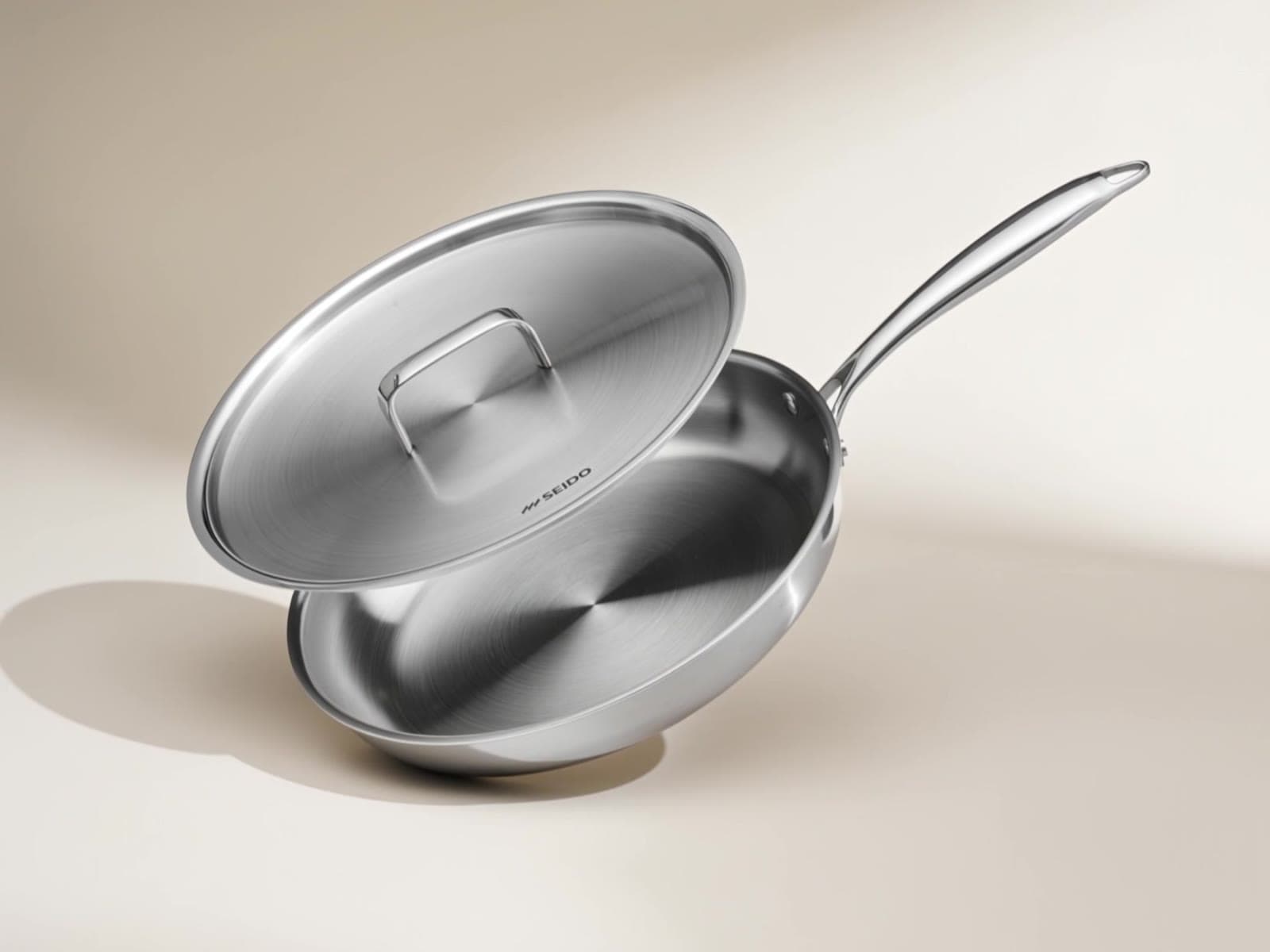
Own the sizes your household cooks for on an ordinary night. Cooking for one: a 20 cm (8 in) pan, or a 24 cm (9.5 in) if you cook full meals. Cooking for two: a 24 cm. A family of three or more, or a weekly batch cook: a 28 cm (11 in), ideally paired with a 20 cm.
Most kitchens need one or two frying pans, not a cupboard full. Size them for the meals you cook every week, not the gathering you host twice a year: a pan that matches your routine gets used, gets familiar through practice and makes the next purchase obvious.
How should your household choose frying pan sizes?
Count the plates you put on the table on an ordinary night, not the biggest dinner you host all year. That number, more than any recipe, decides the size of pan you will reach for most.
The reason is crowding. Food packed too tightly into a pan releases moisture faster than the heat can drive it off, so it steams instead of browning. A pan with enough open surface for your usual servings keeps its heat and gives you a proper sear; a pan far bigger than you need wastes heat and lets oil scorch in the empty spaces.
Cooking for one: which frying pan size?
A 20 cm (8 in) frying pan covers most solo cooking: fried eggs, an omelette, a single chicken breast or fish fillet, a toastie, toasting spices or reheating one portion. It heats quickly, needs little oil and stores anywhere.
If you cook proper meals for yourself — a full stir-fry, a pan sauce, or two portions so tomorrow's lunch is sorted — a 24 cm (9.5 in) gives you room to sear without crowding. Many solo cooks end up with both: the small pan for breakfast, the bigger one for dinner.
Cooking for two: which frying pan size?
A 24 cm (9.5 in) frying pan is the two-person pan. It holds two portions of meat or fish with room to sear, a stir-fry for two or a pan sauce without crowding, and it is still easy to lift and tilt one-handed.
If you add a second pan, make it a 20 cm (8 in) for eggs and side dishes rather than a pan close in size to the first. Two pans of the same job crowd the cupboard; two pans of different jobs earn their space.
Cooking for a family of three or four?
A 28 cm (11 in) frying pan is the family pan. Three or four servings need enough open surface to sear without crowding, and a 28 cm holds two steaks side by side, a one-pan dinner or breakfast for the whole table.
Pair it with a 20 cm (8 in) and most family cooking is covered: the big pan for dinner at scale, the small one for eggs, single portions and quick reheats without heating the large pan.
Batch cooking and meal prep: which size?
If you cook in bulk — a week of lunches, double portions for the freezer, meat browned for a stew or casserole — the 28 cm (11 in) earns its space. The extra surface lets you brown in fewer rounds.
Even a big pan has a limit. Brown in batches so the pan is never crowded, and give it a moment to come back up to heat between rounds; the fond each batch leaves behind becomes the base of the sauce.
Should you buy one frying pan or two?
If you are buying one pan, choose the 24 cm (9.5 in) if you cook for one or two, and the 28 cm (11 in) if you regularly cook for three or more. A single well-chosen frying pan earns its place on the hob every day.
If you are buying two, skip the middle and pair the ends: a 20 cm (8 in) and a 28 cm (11 in). The small pan handles eggs, single portions and quick reheats; the large pan handles dinner at scale. Two pans also let you run components in parallel — protein in the big pan, a sauce or vegetables in the small one — which is how one-pan recipes quietly become faster two-pan dinners.
The honest buying rule: size the pan for the meals you cook weekly, not the gathering you host twice a year.
Should you buy a frying pan set or sizes separately?
A set is convenient when you know you will use every piece. It gives you matching handles, lids and construction in one purchase.
Buying sizes separately lets you skip a diameter you would never reach for, and you store only the pans you use. It also lets you add a size later, once your routine shows a gap.
Either way, compare pieces, not piece counts. Some sets count lids as separate pieces, so a set described by its number of pieces may hold fewer pans than it first appears. Check which diameters are included, and whether each one does a job the others do badly: small for eggs and single portions, medium for weeknight cooking for one or two, large for three or more servings and batch browning.
Whichever route you take, check that every pan suits your hob. Induction hobs only heat pans with a magnetic base, and not every stainless steel is magnetic, so look for the maker's stated hob compatibility rather than assuming it.
Which SEIDO frying pan suits your household?
SEIDO frying pans come in three sizes, each with a matching stainless steel lid: 20 cm (8 in) for solo cooking and eggs, 24 cm (9.5 in) for one or two, and 28 cm (11 in) for families and batch cooks. All three share one construction — a tri-ply clad body with an uncoated 304 (18/8) stainless steel cooking surface, made without intentionally added PFAS — so the choice really is size alone.
Each works on gas, electric, ceramic and induction hobs and carries a 5-Year Limited Warranty. If you are starting with one, the 24 cm (9.5 in) covers everyday cooking for most one- and two-person households. Buy now on Amazon.
Cooking this way is what our 24 cm frying pan is built for.
Frequently asked questions
- What size frying pan do I need for a family of four?
- A 28 cm (11 in) frying pan. Four servings need enough open surface to sear without crowding — when food packs a pan too tightly, its temperature drops and the food steams instead of browning. Pairing the 28 cm with a 20 cm (8 in) covers eggs and single portions without heating the big pan.
- Is a 24 cm frying pan big enough for two people?
- Yes, for everyday cooking. A 24 cm (9.5 in) frying pan holds two portions of meat or fish with room to sear, a stir-fry for two or a pan sauce without crowding. Step up to a 28 cm (11 in) frying pan when you regularly cook three or more servings or batch cook for the week.
- What size frying pan should I buy if I live alone?
- A 20 cm (8 in) frying pan covers eggs, single portions and quick reheats. If you cook full meals, or make two portions to keep one for later, a 24 cm (9.5 in) gives you room to sear without crowding.
- Which two frying pan sizes should I own?
- Pair the ends of the range: a 20 cm (8 in) and a 28 cm (11 in). The small pan handles eggs and single portions; the large pan handles dinner for three or more and batch cooking. If you only ever cook for one or two, a 20 cm and a 24 cm (9.5 in) is the better pair.
- Do you need a lid for a stainless steel frying pan?
- Not for searing or frying, which need moisture to escape. A lid is useful for steaming vegetables, cooking eggs through on top, finishing thick cuts over a lower heat and keeping food warm. A frying pan sold with its own fitted lid saves hunting for one that sits flat on the rim.
- Are frying pan sets worth it?
- A set is worth it when you will use every piece. Compare pieces, not piece counts: some sets count lids as separate pieces, so check which pan diameters are included and whether each does a job the others do badly. Buying sizes separately lets you skip a diameter you would never reach for.
Browse all stainless steel frying pans or keep reading: Can You Cook Acidic Foods in Stainless Steel? · Can You Put a Stainless Steel Pan in the Oven? · How Hot Should a Stainless Steel Pan Be?.
SEIDO 24 cm Stainless Steel Frying Pan
See the 24 cm frying pan