Is Stainless Steel Cookware Safe?
Published 12 October 2026
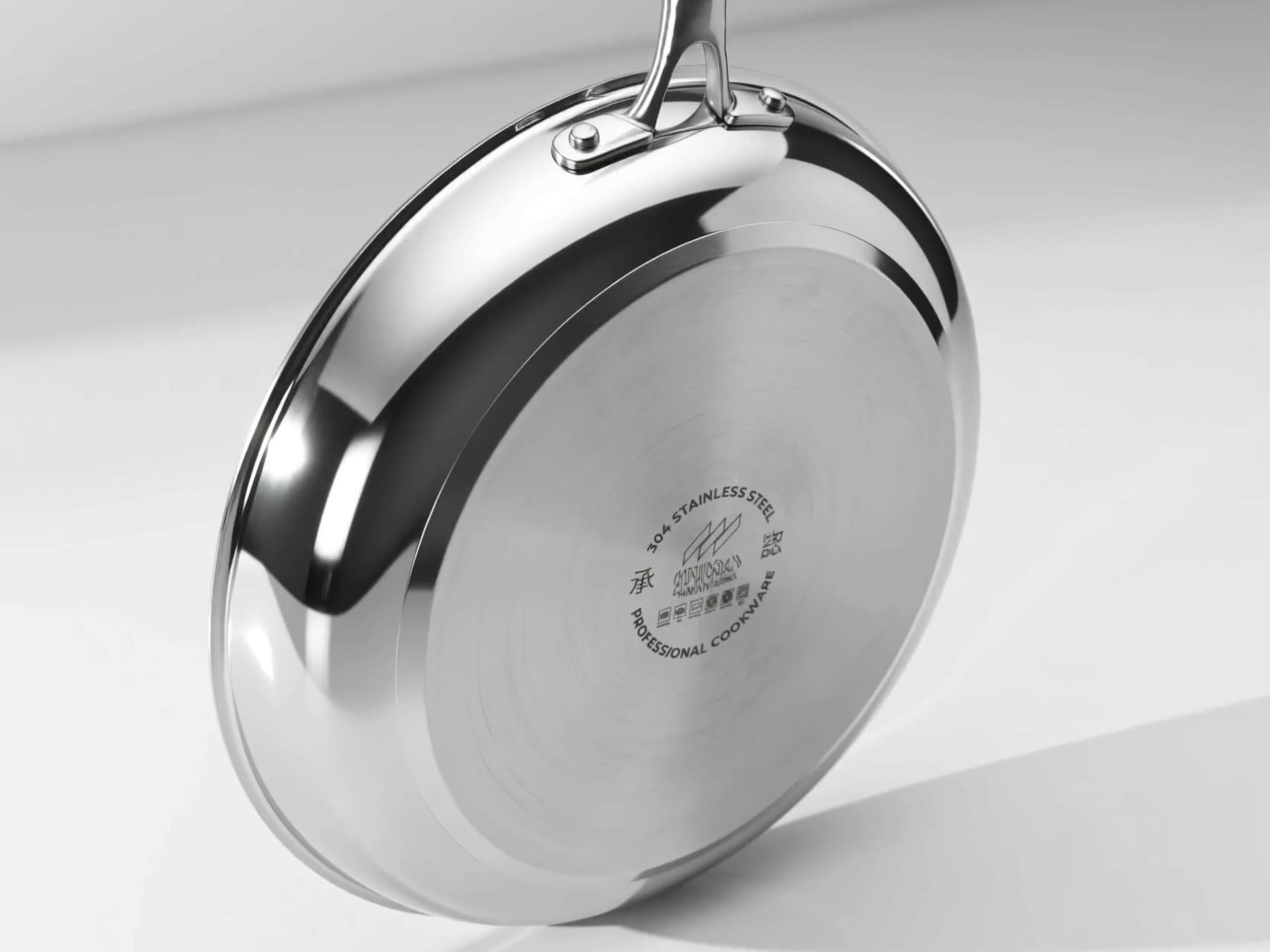
For everyday cooking, yes. Stainless steel is among the longest-established food-contact materials, and 304 (18/8) is a standard food-contact grade used across the food industry. An uncoated stainless steel frying pan has no synthetic coating to degrade, and SEIDO Cookware frying pans are made without intentionally added PFAS and without synthetic coatings.
No material earns trust through absolutes, so here is the honest version: acidic foods and long contact times can transfer trace amounts of metal from any metal cookware, stainless steel included. Stainless steel is chosen across the food industry — for cooking, processing and storage — precisely because it is stable under everyday conditions. The sections below explain the mechanisms plainly.
What is 304 (18/8) stainless steel?
304 stainless steel — also written as 18/8 — is the workhorse food-contact grade of the modern food industry. The numbers describe its two defining alloying elements: roughly 18% chromium and 8% nickel, combined with iron. That composition gives the grade its corrosion resistance, and it is why 304 shows up wherever food is prepared, processed and stored — commercial prep tables, brewing and dairy tanks, mixing bowls and cookware.
Chromium does the protective work. On contact with oxygen, chromium forms an extremely thin, invisible film of chromium oxide across the surface of the steel — the passive layer. It is stable, and it is self-repairing: scratch or scrub the surface, and the exposed chromium re-forms the layer on contact with air. The passive layer is what makes stainless steel stainless. It resists rust and staining, and it places a stable barrier between the iron in the alloy and the food in your pan.
Nickel adds corrosion resistance and structural stability, which is why 18/8 and its close relative 18/10 dominate the 300-series grades used around food. SEIDO Cookware frying pans have a 304 (18/8) stainless steel cooking surface — the grade itself is what touches your food, with no synthetic coating applied over it.
Does stainless steel contain PFAS?
In cookware, PFAS questions are really coating questions. PFAS — per- and polyfluoroalkyl substances — are a family of synthetic compounds historically associated with the slick release coatings applied to non-stick pans. Stainless steel is categorically different: a metal alloy of iron, chromium and nickel. The concern that attaches to non-stick cookware attaches to the coating, not to the steel.
An uncoated stainless steel frying pan changes the shape of the question entirely. There is no coating on the cooking surface — nothing applied over the metal that can scratch, blister or thin with use. A coated pan's cooking surface is a layer engineered to wear over time; an uncoated pan's cooking surface is the material itself.
SEIDO Cookware frying pans are uncoated, built without synthetic coatings and made without intentionally added PFAS. That wording is deliberate. It states plainly what is and is not put into the product instead of reaching for sweeping absolutes — the register a careful buyer should expect from any cookware maker.
Does stainless steel leach metals into food?
The honest answer, for every metal pan ever made, is that metal cookware can transfer trace amounts of metal to food — and that acidic ingredients and long contact times are the conditions that increase it. Stainless steel is not magically exempt, and any answer that pretends otherwise should lower your trust rather than raise it.
What sets stainless steel apart is how little it interacts under normal cooking conditions. The chromium oxide passive layer keeps the surface largely inert towards food, which is precisely why stainless steel became the default material of the food industry — for cooking, for processing and for storage. It is one of the most extensively studied food-contact materials in use, chosen for that role because of its stability, not in spite of it.
In practice, ordinary cooking — searing, sautéing, deglazing, simmering a tomato sauce — is exactly what stainless steel is built for. Transfer from any metal cookware rises mainly when strong acidity meets very long contact, a general property of metals and acids rather than a defect of any single pan. Stainless steel sits at the stable end of that spectrum, which is why the same alloy family trusted for cooking is also trusted for food storage across the industry.
Why does an uncoated cooking surface matter?
A non-stick coating is consumable by design. It is applied as a layer, it delivers release performance while intact, and it thins, scratches and wears with normal use — that is the life cycle of every coated pan, whatever the brand. When people ask whether their ageing non-stick pan is still fine to use, they are really asking about the state of that layer.
An uncoated stainless steel frying pan removes the layer from the equation. There is nothing on the cooking surface to wear off, so there is no coating condition to monitor and no degradation curve to track. The trade is honest: you give up built-in release and learn a small amount of technique — proper preheating, a little fat, patience while a crust forms and releases on its own — and in return the pan has no wearing layer at all. We back our frying pans with a 5-Year Limited Warranty, a commitment made practical by that simplicity: there is no coating whose condition sets a clock on the pan.
How do you check what a frying pan is actually made of?
Material claims are only as good as their specificity. A trustworthy listing names the grade, states clearly whether the cooking surface is coated, and publishes its material information where you can read it. Vague phrases — 'premium stainless', 'professional grade' — tell you very little on their own.
We publish exactly that: SEIDO frying pans have a tri-ply clad body with a 304 (18/8) stainless steel cooking surface, made without intentionally added PFAS and without synthetic coatings. The full material story — the grade, the passive layer and what each product is made of — is on our materials and safety page.
- A named grade: 304, 18/8 or 18/10 signals standard food-contact stainless steel from the 300 series
- A clear coated-or-uncoated statement about the cooking surface
- A materials page you can actually read, not just a bullet point on a listing
- A warranty in writing — SEIDO's is a 5-Year Limited Warranty
Is stainless steel toxic when heated?
Heat changes a coated pan and a bare steel pan in different ways. A coating is a separate layer with its own limits. A bare stainless steel cooking surface has no coating to soften, break down or give off fumes, because the surface is the alloy itself.
What you do see when stainless steel gets hot is colour. Blue, gold or rainbow tints appear where the chromium oxide film thickens with heat. This heat tint is an optical effect of a thicker oxide layer. It is cosmetic, and a mildly acidic cleaner, such as white vinegar or an oxalic acid cleaner, usually removes it.
Smoke from a hot pan comes from the food or the fat, not the steel. Every cooking oil has a smoke point, and oil heated past it breaks down. Match the oil to the heat you plan to use, and preheat an empty pan only until a drop of water beads and skates across the surface.
SEIDO frying pans are oven-safe to 260°C (500°F) for up to 1 hour, lid off; the lid never goes in the oven.
Is 304 stainless steel safe for cooking?
Yes. 304 is the most common food-contact stainless steel grade in use. It is the alloy of commercial prep tables, dairy and brewing equipment, sinks, mixing bowls and cookware.
In cookware, the useful question is which part of the pan is 304. Many stainless frying pans are clad: a stainless cooking surface bonded to an aluminium core, often with a different stainless grade on the outside. The layer that touches food is the one that matters for food contact. A 400-series exterior is common in the category because ferritic steel is magnetic, and induction hobs need a magnetic base to work.
On SEIDO frying pans, the cooking surface is 304 (18/8) stainless steel, over an aluminium core and a 430 stainless steel exterior. The 304 is the part that touches your food.
Is brushed or scratched stainless steel safe?
A brushed finish is a surface texture, not a different material. The steel is abraded in one direction to give a satin look. The alloy, and the chromium oxide layer that forms on it, are the same as on a mirror-polished pan.
Scratches work the same way. Metal utensils leave fine marks on any stainless pan, and the exposed chromium re-forms its oxide layer on contact with air. A scratched stainless cooking surface is still the same stainless steel. That differs from a scratched coating, where the mark goes into a layer that was applied on top.
Two kinds of mark deserve attention. Small pits can form when salt sits undissolved in cold water in the pan, because concentrated chlorides attack the oxide layer; add salt once the water is hot and stir it in. Orange rust specks usually come from carbon-steel wool or iron particles left on the surface, not from the pan itself; use a stainless-safe scouring pad and a stainless steel cleaner, and the specks come away.
- Brushed, satin and polished finishes are the same alloy
- Fine scratches do not change the material you cook on
- Dissolve salt in hot water, not cold, to avoid pitting
- Skip carbon-steel wool on stainless steel
Cooking this way is what our 24 cm frying pan is built for.
Frequently asked questions
- Is 18/10 stainless steel better than 18/8?
- Both are standard food-contact grades from the same 300-series family, and the numbers describe composition, not a safety ranking: 18% chromium alongside 8% or 10% nickel. Both form the same protective chromium oxide passive layer. The extra nickel in 18/10 adds corrosion resistance and a brighter finish, which is why it is common in cutlery, but for cookware both grades do the same food-contact job.
- Is uncoated stainless steel safer than non-stick?
- The honest framing is not a ranking but a difference in what can change over time. A non-stick coating is a layer that wears with use, so its condition becomes something to monitor as the pan ages. An uncoated stainless steel surface has no coating to wear off — the surface you cook on is the material itself. That is why we make our frying pans uncoated, made without intentionally added PFAS.
- Can you cook acidic foods like tomato sauce in stainless steel?
- Yes. Stainless steel is used throughout the food industry for acidic preparation precisely because its chromium oxide passive layer keeps the surface stable. As with any metal cookware, very long contact with strongly acidic food can increase trace metal transfer — a general property of metals and acids — but ordinary cooking, deglazing and simmering are exactly what the material is designed for.
- Is heat tint on stainless steel harmful?
- No. The blue, gold or rainbow colour that appears on hot stainless steel is heat tint, a thicker layer of the chromium oxide film that forms naturally on the surface. It is an optical effect and cosmetic. A mildly acidic cleaner, such as white vinegar or an oxalic acid cleaner, removes it.
- What are SEIDO frying pans made of?
- SEIDO frying pans have a tri-ply clad body: a 304 (18/8) stainless steel cooking surface, an aluminium core and a 430 stainless steel exterior. The cooking surface is uncoated, made without intentionally added PFAS and without synthetic coatings, and every pan carries a 5-Year Limited Warranty. They are sold in the UK on Amazon.co.uk in 20 cm (8 in), 24 cm (9.5 in) and 28 cm (11 in), and the full material details are on our materials and safety page.
- Should people with a nickel allergy avoid stainless steel cookware?
- It is a question for your doctor. 18/8 stainless steel contains roughly 8% nickel, and acidic food held in the pan for a long time draws out more metal than brief cooking. Shorter contact with acidic food means less transfer. Ferritic grades such as 430 contain little or no nickel.
Browse all stainless steel frying pans or keep reading: Can You Cook Acidic Foods in Stainless Steel? · Can You Put a Stainless Steel Pan in the Oven? · How Hot Should a Stainless Steel Pan Be?.