Can You Microwave Stainless Steel?
Published 12 October 2026
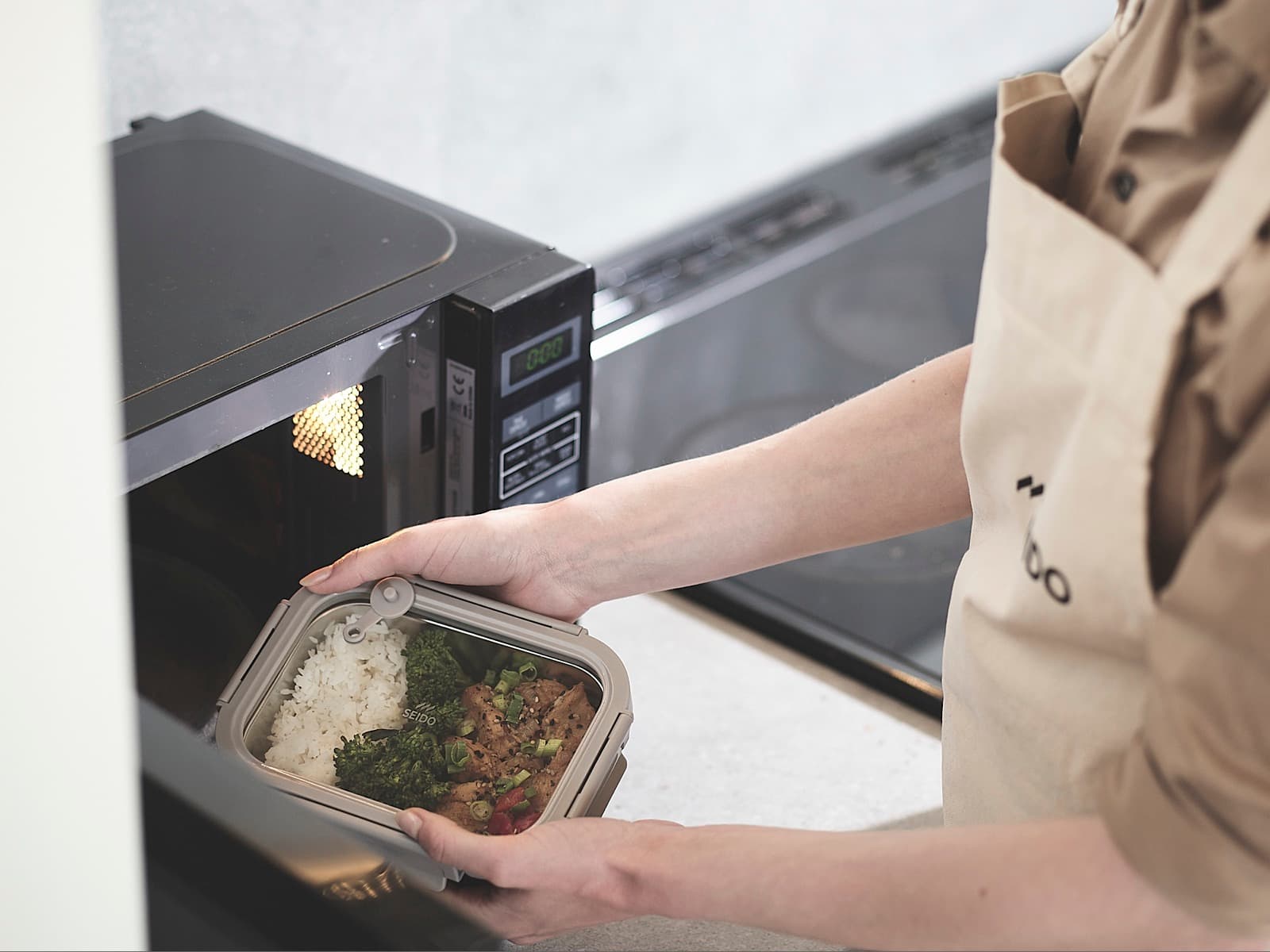
Generally, no — most metal containers don't belong in the microwave. Microwaves reflect off metal instead of passing through it, so food heats unevenly and thin edges can spark. The exception is metal designed for microwave use: SEIDO Cookware's stainless steel lunch boxes are microwave-safe by design, used with the lid off.
The container was lab-tested in a 1000 W microwave: use it with food inside, the lid off and no more than 1000 W, and never heat it empty. Below is why ordinary metal and microwaves don't mix, and how a steel container can be engineered to.
Can you microwave stainless steel?
Generally, no. Most stainless steel containers — mixing bowls, travel mugs, pans, generic bento boxes — were never designed for microwave use. Put one in anyway and two things go wrong: the metal reflects the microwave energy, so your food heats slowly and unevenly, and thin points or sharp edges can concentrate electrical charge and spark. That's why the standard advice is to keep metal out of the microwave — and as a default rule, it's good advice.
But it's a default, not a law of physics. Microwave-safe metal exists when a piece is deliberately designed for microwave use. Our stainless steel lunch boxes are one example: they're microwave-safe by design, used with the lid off, engineered specifically so you can reheat a packed meal without decanting it into plastic first.
The deciding factor is never the material alone. It's whether the manufacturer designed and designated that specific piece for microwave use. If the maker says microwave-safe, follow its conditions exactly. If the maker says nothing, assume it isn't.
Why doesn't metal usually go in the microwave?
A microwave oven heats food by broadcasting radio waves — around 2.45 gigahertz — into the cooking cavity. Polar molecules in food, mostly water, try to align with the rapidly flipping electromagnetic field. All that molecular jostling creates friction, and friction becomes heat. It's why moist foods heat quickly and bone-dry foods barely respond.
Metal behaves differently. Its free electrons make it a conductor, so instead of absorbing microwave energy the way water does, metal reflects it. A closed or mostly closed metal container acts as a shield: the waves bounce off the walls and can only reach your food through whatever opening there is at the top. The result is food that heats slowly, unevenly or barely at all — while the reflected energy bounces back through the cavity.
The second problem is geometry. The oscillating field induces currents in the metal, and those currents concentrate wherever the metal is thin, sharp or crumpled — fork tines, a torn edge of kitchen foil, the gold trim on a decorated plate. Charge builds at those points until it jumps through the air as a visible spark. An arc is rarely dramatic, but it can pit the metal, scorch nearby food or packaging and, with repeated exposure, stress the oven's components.
Here's the part the standard warning leaves out: the inside of every microwave oven is a metal box. Metal itself isn't forbidden in a microwave — it's fundamental to how the oven works, containing and reflecting the waves so they cook your food instead of escaping. The hazard comes from uncontrolled metal: shapes, edges and placements the oven was never designed to accommodate.
How can a stainless steel lunch box be microwave-safe?
Because microwave-safe metal is an engineering outcome, not a material property. When a manufacturer designs a metal piece specifically for microwave use, the same physics that makes random metal risky can be accounted for from the start — the overall shape of the piece, its edges and how it behaves in the oven's field are design decisions, not accidents. This is established territory, too: microwave crisper trays are metal, and some microwave ovens come with metal racks that are safe precisely because they were engineered and positioned for that oven's field.
Our stainless steel lunch boxes sit in this category. Microwave reheating isn't an afterthought or a marketing line — it's an engineered feature of the product. They're designed for microwave use and designated microwave-safe by the manufacturer, and the container was lab-tested in a 1000 W microwave with the lid off. Use it within those conditions: lid off, no more than 1000 W, never empty.
That designation is the whole test. A manufacturer that has genuinely designed a metal container for microwave use will say so explicitly, because it's a significant engineering commitment. Silence means the opposite: if a stainless steel container carries no microwave-safe marking, treat it as unsafe for the microwave — no matter how similar it looks to one that does.
What's the safe way to reheat food in a microwave?
Good microwave practice is the same whatever your container is made of, because microwave heating is inherently uneven — the field has hot and cold spots, and dense foods heat from the outside in. A few habits fix most of it:
- Only microwave containers their manufacturer explicitly marks microwave-safe — metal, glass, ceramic or plastic alike.
- Follow the manufacturer's conditions exactly. For SEIDO lunch boxes: food in the container, lid off (or lid on with its steam vent fully open and clear), never overfilled, a microwave of up to 1000 W, stirring every 3 minutes, one container at a time, clear of the walls — never empty, never with foil.
- Heat in short bursts rather than one long blast, and check as you go.
- Stir or turn the food midway so the cold spots heat through.
- Spread food in an even layer instead of a tall mound — thin layers heat through more evenly.
- Let food stand for a minute after heating; the remaining heat evens out the temperature.
- Check that it is steaming hot all the way through before you eat, and reheat leftovers only once — the Food Standards Agency's advice for reheated food.
- Follow the specific instructions that came with your container — the manufacturer knows its product best.
What should you look for in a microwave-safe stainless steel lunch box?
Start with the only non-negotiable: an explicit microwave-safe designation from the manufacturer, with its conditions — not an assumption based on material or looks. From there, look for real-meal capacity and a stainless steel interior. The chromium in stainless steel forms a self-repairing oxide layer that resists corrosion and staining, which is why steel shrugs off the marks that sauces, curries and dressings can leave on plastic.
Our stainless steel lunch box 3-pack was built around exactly this use: three 800 ml (27 oz) stainless steel containers, each microwave-safe by design with the lid off. Pack a meal, carry it on the commute, and reheat it at the office or the gym in the container it travelled in — no transferring to plastic, no second container to wash. The set carries a 5-Year Limited Warranty (lid parts: 1 year).
Packing this way is what our lunch box 3-pack is built for.
Frequently asked questions
- Is it dangerous to microwave metal?
- It's usually less dramatic than the warnings suggest, but it's still a bad idea for metal that isn't designed for it. Reflected microwaves mean your food heats poorly, and thin or sharp metal points can arc — pitting the metal, scorching nearby material and stressing the oven over time. Save the microwave for containers their maker marks microwave-safe.
- Why are SEIDO's stainless steel lunch boxes microwave-safe when most metal isn't?
- Because they're designed for it. Microwave-safe metal is an engineering outcome, not a material property — the same physics that makes a random metal bowl risky can be accounted for when a piece is engineered for microwave use from the start. SEIDO's lunch boxes are designed and designated microwave-safe by the manufacturer, for use with the lid off. Reheat within the conditions the container was lab-tested under: food in the container, lid off, a microwave of up to 1000 W, one container at a time, clear of the walls.
- Can the lid stay on when you microwave a SEIDO lunch box?
- Lid off is recommended. If the lid stays on, its steam vent must be fully open and clear, with food at least 1 cm (1/2 in) below the rim so nothing touches the lid. Steam builds pressure in a closed container and can push the lid off or splash food, so never heat it with the vent closed or blocked.
- Can I microwave other metal containers if they look similar?
- No — never assume. A microwave-safe designation applies to a specific engineered product, not to a material or a shape. Two stainless steel containers can look nearly identical and behave completely differently in a microwave. Only microwave a metal container if its own manufacturer explicitly marks it microwave-safe.
- Can you microwave a stainless steel frying pan or mixing bowl?
- No. Stainless steel frying pans are designed for the hob, where conducted heat is the whole point, and ordinary mixing bowls carry no microwave-safe designation. To reheat leftovers, transfer the food to a container whose manufacturer marks it microwave-safe — or store meals directly in one, such as a stainless steel lunch box designed for microwave reheating.
Browse all stainless steel lunch boxes or keep reading: Can a Stainless Steel Lunch Box Go in the Oven? · Can You Freeze Food in Stainless Steel Containers? · Is It Safe to Microwave Food in Plastic Containers?.