How to Season a New Stainless Steel Pan — and Why You Don't Need To
Published 5 November 2025 · Updated 12 October 2026
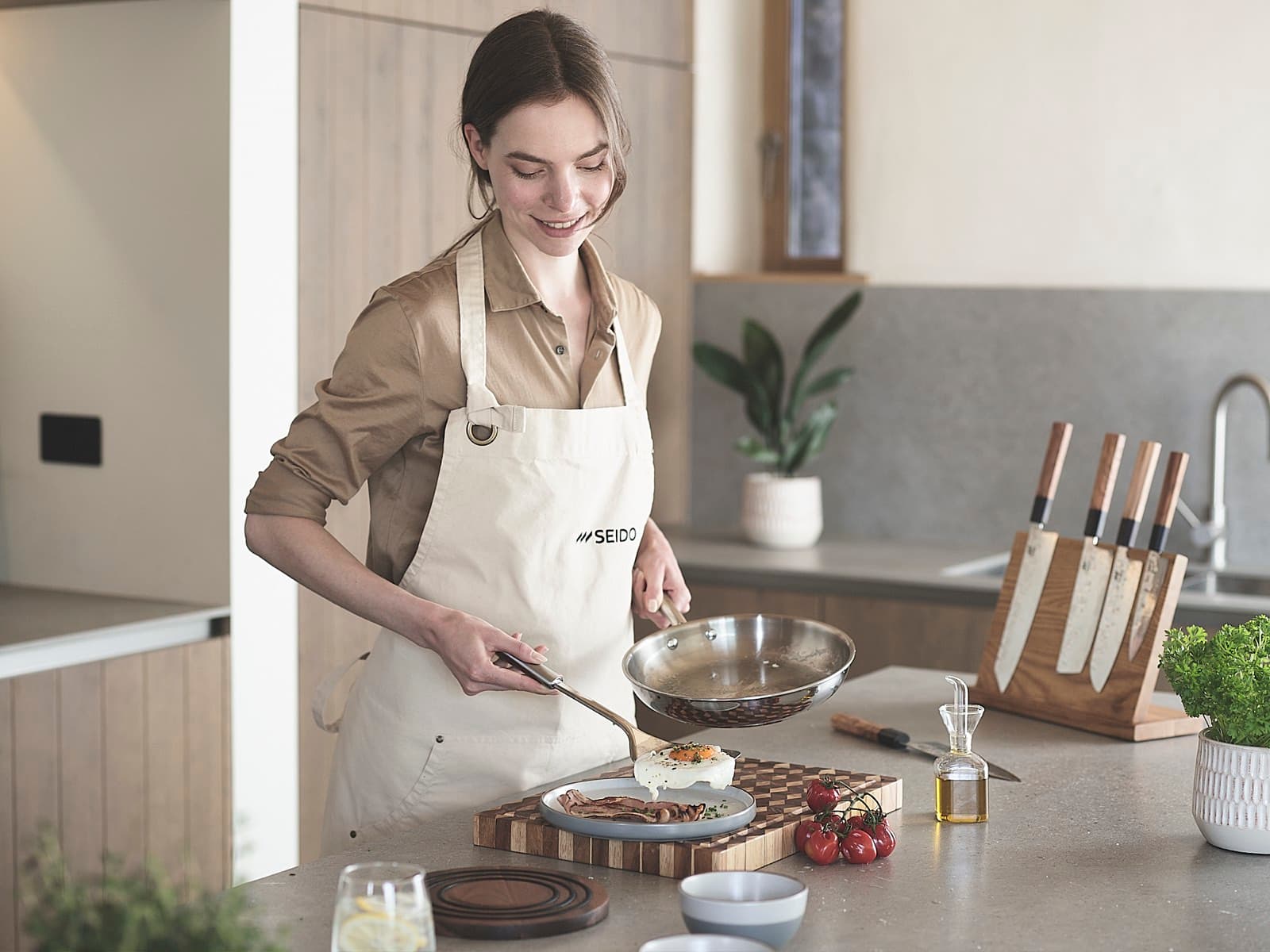
You don't need to season a new stainless steel pan. Seasoning protects bare iron from rust, and stainless steel protects itself: the chromium in 304 (18/8) stainless steel forms a thin oxide layer that repairs itself. A new pan needs a wash and a dry, then a proper preheat every time you cook.
If you season it anyway, the oil film is temporary: it washes off, wears unevenly, and if it is heated hard it can harden into a sticky brown film you will later have to scrub off. Preheating and the right amount of fat do the job seasoning is supposed to do.
Do you need to season a stainless steel pan?
No, and understanding why clears up most stainless steel frustration. Seasoning exists to solve a cast iron problem: bare iron rusts, so cast iron gets a coat of polymerised oil that protects the metal and builds a slick surface over years of use. Stainless steel doesn't have that problem. The chromium in 304 (18/8) stainless steel forms a thin, self-repairing oxide layer that protects the surface on its own, with no oil coat to apply and no routine to keep up.
Some guides suggest seasoning stainless steel anyway, and a temporary oil layer can form. But it is exactly that: temporary. It washes off, wears unevenly, and chasing it means treating a stainless steel pan like something it isn't. The pan is designed to work bare.
What should you do with a new stainless steel pan before you cook?
Getting a new pan ready takes a few minutes, and none of it involves oil:
- Remove all packaging, labels and stickers. Soak off any glue with warm, soapy water rather than scraping it with a knife.
- Wash the pan and its lid in warm water with washing-up liquid, then rinse.
- Dry both fully with a tea towel, which also stops water spots forming.
- Check that the handles on the pan and the lid are firm. If a handle is loose, don't use the pan; contact us instead.
- Then cook. The first meal needs the same preheat as every meal after it.
What happens if you season stainless steel anyway?
Most methods for seasoning stainless steel heat a thin film of oil in the pan until it bonds to the surface. On stainless steel that film doesn't last. The steel is far smoother and denser than cast iron, so the layer has little to hold on to, and an ordinary wash with washing-up liquid takes most of it away.
What does last is the residue that goes wrong. When a thin layer of fat is heated hard, or left on the pan and heated again, its molecules link together into a hard, varnish-like coating. It's the same chemistry that builds seasoning on cast iron; on stainless steel it shows up as a sticky amber or brown film, often around the sides and rim, and soap alone rarely shifts it.
If that film has already built up, a paste of roughly three parts bicarbonate of soda to one part water, left for 15 to 20 minutes and then scrubbed with the rough side of a sponge, removes most of it. Our guide to removing stains from stainless steel cookware covers older, darker layers.
If not seasoning, what stops food from sticking?
Preheating. Sticking on stainless steel is almost always a temperature problem, not a surface problem. Food pressed onto a cool steel surface bonds to it; food placed on a properly preheated surface releases as a crust forms.
Patience at the end matters as much as the preheat. Seared food clings while the crust builds, then lets go. Pull it early and you tear it; wait, and it releases cleanly. The routine that works:
- Preheat the dry pan over a medium heat for a couple of minutes.
- Test it with a few drops of water. When they bead into little balls that skate around the surface, rather than flattening and hissing away, the pan is ready.
- Add your fat and let it shimmer briefly.
- Add the food and leave it alone until it releases on its own.
How do you keep a stainless steel pan in good shape?
This is the everyday advantage of an unseasoned, uncoated surface: nothing on it needs protecting. You can scrub hard with a scouring pad, soak off stuck bits and use metal utensils. There's no seasoning to strip and no coating to scratch. The same steel is there after every wash, and the water-drop test works the same on the two-hundredth wash as on the first.
Wash and dry the pan after every use, including the outside and the rim where oil collects, so no film builds up. Our Sear Series frying pans are built on exactly this principle: a tri-ply clad body with an uncoated 304 (18/8) stainless steel cooking surface, made without intentionally added PFAS, that asks for a couple of minutes of preheating rather than a seasoning routine. They come in 20 cm (8 in), 24 cm (9.5 in) and 28 cm (11 in), each backed by a 5-Year Limited Warranty.
Cooking this way is what our 24 cm frying pan is built for.
Frequently asked questions
- Why does food stick to my new stainless steel pan?
- Almost always because the pan wasn't fully preheated before the food went in, or the food was moved before a crust formed. It isn't because the pan hasn't been seasoned. Preheat the dry pan over a medium heat until water drops bead and skate, add fat, then let the food release on its own.
- Can you ruin a stainless steel pan by not seasoning it?
- No. Stainless steel protects itself: its chromium oxide layer re-forms on its own. There's nothing to ruin by skipping a seasoning step, because the pan was never meant to have one.
- Should you wash a new stainless steel pan before using it?
- Yes. Remove the labels, wash the pan and lid in warm water with washing-up liquid, then rinse and dry them fully. That's all the preparation it needs: no oil coat and no oven step. From then on, preheat it before every cook.
- Is a seasoned cast iron pan better than stainless steel?
- They're different tools. Cast iron holds heat well and relies on its seasoned surface. Stainless steel is lighter, responds faster when you change the heat, needs no upkeep routine and cleans without any worry about stripping a coat. For searing, pan sauces and easy care, stainless steel is the practical everyday choice.
Browse all stainless steel frying pans or keep reading: Can You Cook Acidic Foods in Stainless Steel? · Can You Put a Stainless Steel Pan in the Oven? · How Hot Should a Stainless Steel Pan Be?.
SEIDO 24 cm Stainless Steel Frying Pan
See the 24 cm frying pan