How to Remove Stains from Stainless Steel Cookware: Rainbow Tint, Brown Film and White Spots
Published 5 December 2025 · Updated 12 October 2026
Most stains on stainless steel cookware come off at home. Rainbow, gold or blue heat tint usually wipes away with diluted white vinegar. A sticky brown film is polymerised oil, which a bicarbonate of soda paste lifts. White spots are minerals from tap water, and vinegar dissolves them. Pitting and warping are damage, not stains.
Stainless steel doesn't stain the way a porous material does, because nothing soaks into it. What you see is almost always something sitting on the surface, or a change in the steel's thin outer film. Match the mark to its cause below, and the right cleaner usually shifts it.
What kind of stain is on your pan?
Six marks cover almost every stained or discoloured pan. Match yours to the list, then go to its section:
- Rainbow, gold, purple or blue tint, often in rings or patches: heat tint.
- Sticky amber or brown film, often where oil pooled or dripped: polymerised oil.
- Black or dark brown crust: burnt-on food.
- White, chalky or cloudy spots after washing or boiling: mineral or starch deposits.
- Tiny pinprick dots in the base that won't scrub out: pitting.
- A base that rocks on a flat hob or lets oil run to one edge: warping.
How do you remove rainbow or blue heat tint?
Rainbow and blue marks are heat tint. Stainless steel stays stainless because the chromium in the alloy reacts with oxygen to form a very thin, transparent oxide film over the surface. Heat speeds up that reaction, so the film grows thicker wherever the pan runs hottest.
Once the film is thick enough, light reflecting off its top surface interferes with light reflecting off the metal underneath, and that interference is what you see as colour — the same effect that colours a soap bubble. A thinner film reads straw or gold; a thicker one reads brown, then purple, then blue. A rainbow gradient simply maps how the temperature varied across the pan. The usual causes are an empty pan preheated on high, a gas flame that reaches up the sides, or a hob ring much smaller than the base, which concentrates heat in the centre.
To remove it, let the pan cool, wipe the tinted area with diluted white vinegar on a soft cloth, then wash, rinse and dry. A mild acid lifts the tinted film. For a stubborn tint, use a powdered or cream cleaner made for stainless steel cookware that contains oxalic acid, and follow the label. The steel's ordinary, invisible oxide film re-forms on its own in air. Expect the tint to come back when you cook hot; that's normal.
How do you get brown stains off stainless steel?
A brown or yellow film that feels slightly tacky, or won't budge with washing-up liquid, is polymerised oil. When a thin layer of fat is heated hard, or left on the pan and heated again, its molecules link together into a hard, varnish-like coating. It's the same chemistry that builds seasoning on cast iron; on stainless steel it just looks like a stain.
Soap alone rarely shifts it, because the film is no longer liquid fat. Work through these in order:
- Bicarbonate of soda paste. Mix roughly three parts bicarbonate of soda to one part water, spread it over the film, leave it for 15 to 20 minutes, then scrub with the rough side of a sponge.
- A stainless steel cookware cleaner. For older, darker layers, use a powdered or cream cleaner made for stainless steel cookware and follow the label.
- Prevention. Wash the pan fully after every use, including the outside and the rim where drips collect, and don't let oil smoke hard before the food goes in.
What about black, burnt-on food?
A black or dark brown crust is carbonised food sitting on the steel, not a stain in it. Deal with it while the pan is still warm: pour in a little water, let it steam and scrape with a wooden spoon. If the crust survives, soak the pan in hot water with washing-up liquid, then try the bicarbonate of soda paste above, or simmer water with a few tablespoons of bicarbonate of soda in the pan for 10 to 15 minutes. Our stainless steel pan care guide takes you through each step.
How do you remove white spots and cloudy marks?
White, chalky spots are usually minerals. Tap water carries dissolved calcium and magnesium, and when a drop of water evaporates on the steel, those minerals stay behind. Hard water leaves more, so the spots show up most in hard-water areas. Boiling pasta, rice or potatoes can leave a similar cloudy white film made of starch.
Both come off easily. For mineral spots, wipe with diluted white vinegar, because the acid dissolves the calcium deposits, then wash, rinse and dry. For a starch film, a normal wash with washing-up liquid and a sponge is usually enough. To stop spots forming, dry the pan with a tea towel straight after washing instead of leaving it to air-dry.
Can you remove pitting from a stainless steel pan?
No. Small pinprick dots, often clustered on the base, that no amount of scrubbing removes are pitting. This is the one mark in this guide that is corrosion rather than a surface film, and it is permanent: it can't be polished out.
In a kitchen, pitting almost always comes from chloride, and the chloride usually comes from salt. Salt added to cold water sinks and sits undissolved on the steel while the pan heats. That concentrated chloride can break through the protective oxide film at a single point and corrode a tiny pit. Chlorine bleach attacks the film the same way. So prevention is everything:
- Add salt once the water is boiling, and stir until it dissolves.
- Don't leave salty or acidic food sitting in the pan for hours.
- Keep chlorine bleach away from stainless steel.
Why did my pan warp, and can it be prevented?
Warping isn't a stain, but it often turns up alongside them. Metal expands as it heats and contracts as it cools. When one part of a pan changes temperature much faster than another, the parts expand or contract by different amounts. If the difference is large and sudden, the base can bend and stay bent. That's thermal shock.
Clad pans, such as the tri-ply construction common in stainless steel cookware, add a second factor. Aluminium expands more than stainless steel for each degree of heat, so bonded layers of different metals are always under some stress as they heat and cool, and a fast, uneven temperature swing adds to it. Three habits cause most warping:
- Cold water poured into a very hot pan. Let the pan cool for a minute or two before it goes under the tap.
- An empty pan left on a high heat. Preheat over a medium heat, and only for as long as the recipe needs.
- A hob ring that doesn't match the base. A small, very hot ring under a large pan heats the centre far faster than the edges.
Do stains shorten a stainless steel pan's life?
There's no fixed lifespan for a stainless steel pan, because it depends on how the pan is used and cared for. What we can say is what ends a pan's working life. A coated pan has a coating that wears with heat, utensils and washing. An uncoated stainless steel pan has no coating to wear out, so its working life depends on avoiding damage.
So heat tint, oil film and mineral spots are reversible, however often they appear, while warping and pitting are largely avoidable once you know about thermal shock and salt.
Does discolouration count as a warranty defect?
No. Rainbow, blue or golden tinting on stainless steel is a normal result of heat — a thin surface layer that changes how light reflects, not a flaw in the material. It affects appearance only and can be removed at home. Our 5-Year Limited Warranty covers defects in materials and workmanship under normal home use, in addition to your statutory rights. It doesn't cover normal wear, discolouration from use, damage from misuse (such as drops, or overheating an empty pan on a high heat) or commercial use. If you're not sure whether a problem is wear or a defect, email customerservice@seidocookware.co.uk with your Amazon order number and a photo. We'd rather look than have you guess.
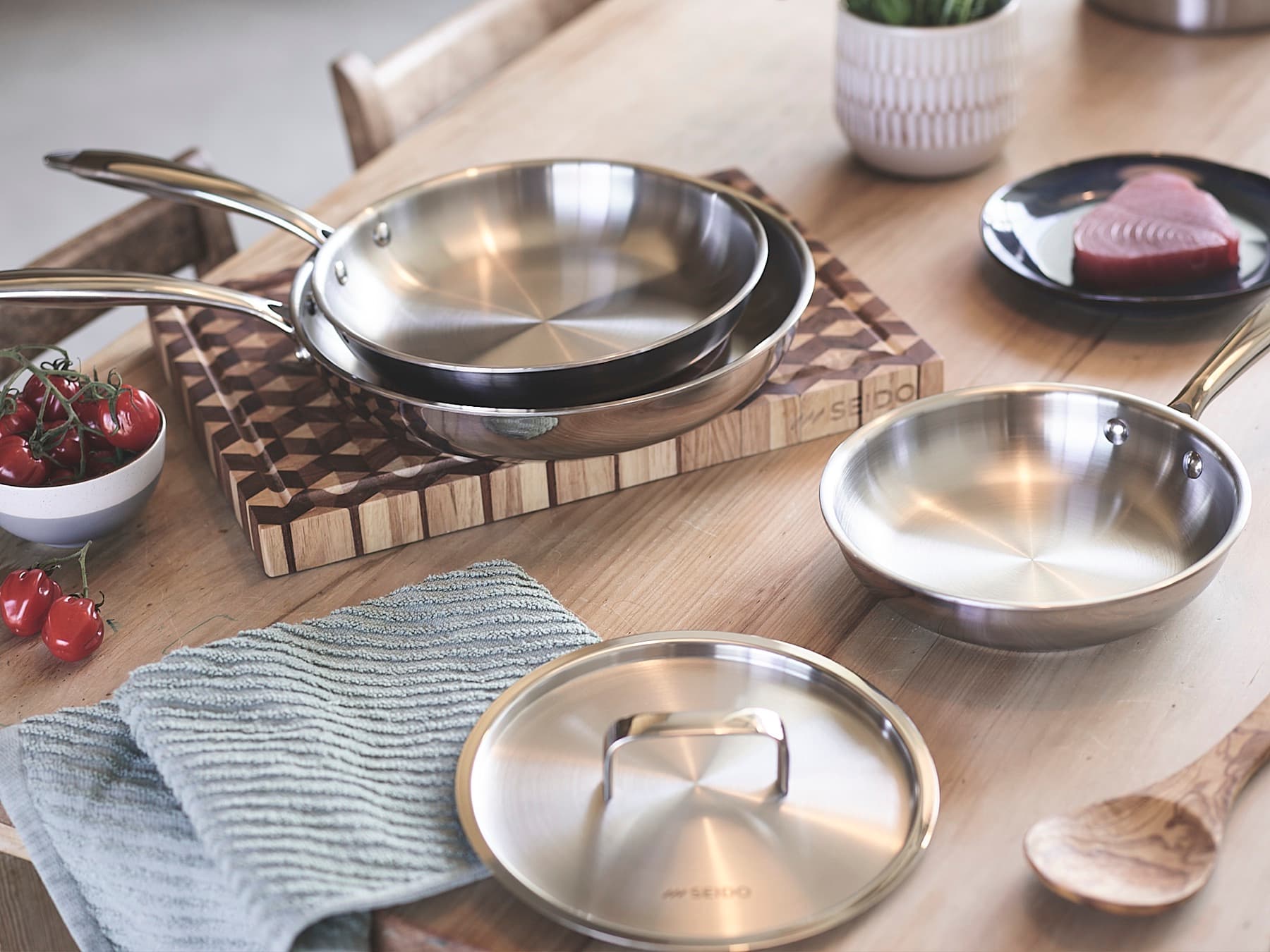
SEIDO frying pans will heat-tint like any stainless steel, and the advice in this guide applies to them. The cooking surface is 304 (18/8) stainless steel, uncoated, made without intentionally added PFAS and without synthetic coatings, so there is no coating to wear through when you scrub off oil film or tint. The 20 cm (8 in), 24 cm (9.5 in) and 28 cm (11 in) frying pans are each sold with a lid and backed by a 5-Year Limited Warranty.
Cooking this way is what our 24 cm frying pan is built for.
Frequently asked questions
- Is rainbow discolouration on a stainless steel pan damage?
- No. Rainbow, gold or blue discolouration is heat tint. The thin oxide film on the steel grows thicker with heat, and light reflecting through that film shows up as colour. It affects appearance only, doesn't change how the pan cooks, and usually wipes away with diluted white vinegar followed by a wash and dry.
- Does vinegar remove heat tint from stainless steel?
- Usually, yes. Diluted white vinegar wiped over the cooled pan with a soft cloth lifts light heat tint, and it also dissolves white mineral spots. Wash, rinse and dry afterwards. For a stubborn tint, use a cleaner made for stainless steel cookware that contains oxalic acid, following the label.
- Why won't washing-up liquid shift the brown stains on my pan?
- Brown stains that resist soap are usually polymerised oil. Fat heated hard, or left on the pan and heated again, bonds into a hard, varnish-like film that washing-up liquid can't dissolve. A bicarbonate of soda paste left for 15 to 20 minutes and then scrubbed removes most of it, and a stainless steel cookware cleaner handles older layers.
- Can a warped stainless steel pan be fixed?
- Not reliably at home. Hammering a warped base can dent the steel or stress a clad pan's bonded layers without making it truly flat. Prevention works better: don't pour cold water into a hot pan, don't leave an empty pan on a high heat, and match the hob ring to the base.
- Why does salt cause pitting in stainless steel?
- Salt is sodium chloride, and concentrated chloride can break through the protective oxide film on stainless steel at a single point, corroding a small pit. Undissolved salt sitting on the base of a heating pan is the classic cause. Add salt once the water boils, and stir until it dissolves. Pits are permanent.
Browse all stainless steel frying pans or keep reading: Can You Cook Acidic Foods in Stainless Steel? · Can You Put a Stainless Steel Pan in the Oven? · How Hot Should a Stainless Steel Pan Be?.
SEIDO 24 cm Stainless Steel Frying Pan
See the 24 cm frying pan